
I find my father’s letter. I can feel the paper and its folds. The typewritten letters are themselves relics of another era, when paper set the pace of life. I don’t remember saving it, and yet it has only recently come back to life. As I hold it in my hands, my father’s passion for politics slips through the lines — the same passion that has accompanied him all his life.
I read it several times. Standing up. It says: “The political campaign is heating up more and more, and at times it is impossible — or very risky — to pass through certain streets and avenues of San José because tempers are running high.” I pause at that phrase. Very risky. That is not how I had stored those elections in my memory.
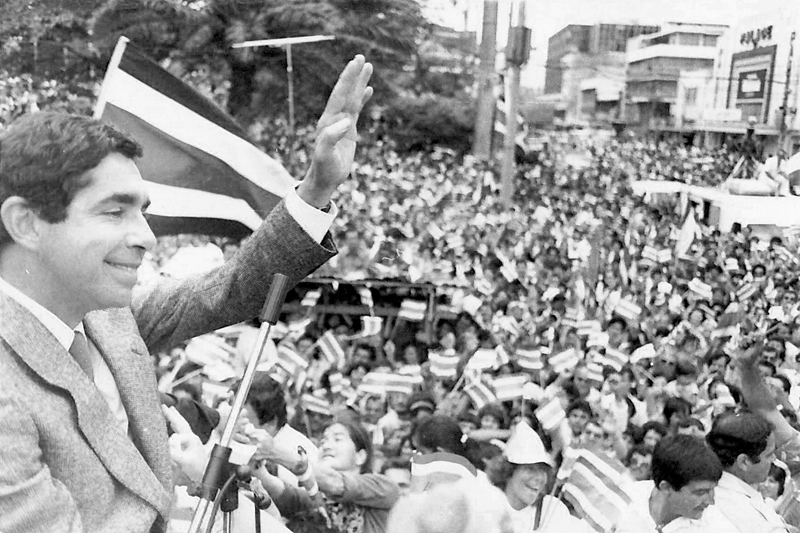
For me, elections in the eighties and nineties had always been a celebration. Flags handed out on street corners, car horns blaring, improvised caravans moving through the city. Public squares as centers of gravity, where people gathered to argue, chant slogans, hold differences without giving up the joy. Politics spilling into the streets. Like a carnival.
And yet my father spoke from another place: from concern, from vigilance, from the adult knowledge that a presidential election can be intense — and that such intensity can also burn.
In February 1986, I was not there to see it for myself. I was in Oregon, on my first student exchange, undergoing a different kind of initiation. It was my first real winter. I was living with a deeply religious family, kind but far removed from my world. The cold was not only a matter of temperature; it was another way of being, moving, speaking. Everything seemed covered by a layer of silence.
On Sunday, February 2 — election day — there were no ballot boxes or flags. We went skiing. I was a beginner, poorly equipped, wearing jeans and a jacket meant for tropical rain, not for slopes turned to ice. After my fourth fall, lying in the snow with numb legs and hands, I wondered what on earth I was doing there. What I was doing in that frozen landscape when, back in Costa Rica, the city was alive with noise, color, and jubilation.
And it wasn’t just any presidential election. My uncle, Álvaro Montero, was running as a candidate for Pueblo Unido. We knew he had little chance; we all knew. But the celebration did not depend on the outcome. The celebration was the celebration. I was missing the handing out of flags, the walk toward the square, the moment he would give his speech. I was missing that collective ritual that had shaped my childhood: accompanying my father to public rallies, debating at home, feeling that politics lived close to the skin.
There was something deeply formative in all of that, though I couldn’t have named it at the time. There were two schools. There was the formal one, with its civics lessons and dates to memorize. And there was this other one — the street — where you learned to live with difference, to tolerate other people’s noise, to inhabit shared space. It wasn’t just about voting; it was about being there.
While I struggled to keep my balance on skis, in San José, according to my father’s letter, tempers were running high. Perhaps both things were true at once: the celebration and the tension, enthusiasm and caution. Perhaps that was precisely why that school worked. Because it wasn’t naïve. Because it taught in the midst of disorder, excess, friction.
Today, four decades later, I walk out of my house and struggle to see a flag in the streets — at least near where I live. I look for signs, traces of that celebration, and find little. Online, there are photos of people gathered outside debates or party meetings, but the general pulse feels different. It seems like another country. If it weren’t for what circulates on social media, one might have to go door to door to see whether anyone inside still cares.My father’s letter has made me long for that celebration I didn’t attend. Not only out of nostalgia, but because something essential was learned there, without anyone intending it: that democracy does not happen in silence. That it requires presence, bodies, shared noise. That it, too, is a form of education.
I fold the letter carefully and return it to its place. Outside, there are no horns, no flags. But for a moment, as I put the paper away, I feel that that parallel school — the one I never fully attended — is still speaking to me, like a lesson unfinished, still worth hearing.