
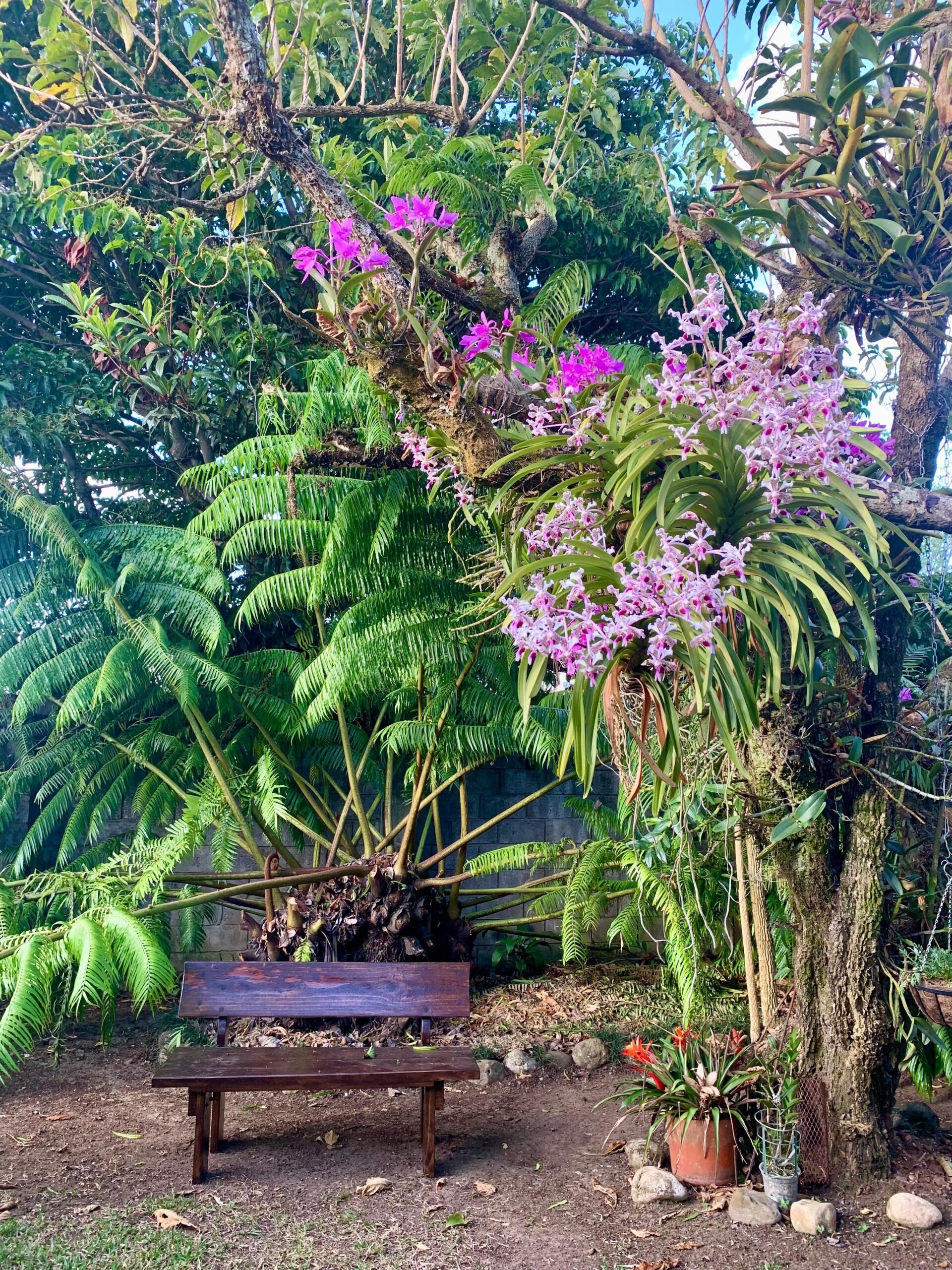
My father kept an orchid greenhouse for many years. It wasn’t very large, but to me it had the density of a world of its own. I remember the filtered light, the humidity in the air, the flowered stems he arranged with such care. From an early age, I learned that orchids do not thrive in neglect: they require attention, consistency, and patience.
What I never learned was how to care for them.
I didn’t know how much to water them, when to prune, or what to do with a stem once it had finished blooming. I admired orchids, but I didn’t intervene. The greenhouse was a place that fascinated me and, at the same time, felt чужe—almost as if it demanded a kind of attention that wasn’t mine.
Perhaps that’s why, a few months ago, when we came to see the house, we would eventually buy, what caught my attention wasn’t the kitchen or the light in the living room, but the orchids. The owner had several—flowerless—arranged along the branches of a güitite tree in the backyard. For a moment, I found myself silently negotiating with the universe, hoping she would have a very good reason not to take them with her, until she told us she would leave them behind.
I felt a deep, unexpected joy.
Before we left, she warned me:
“Don’t even think about watering them, or they won’t bloom.”
It sounded strange, but I nodded.
We moved in mid-January. Between open boxes and small domestic decisions, the orchids remained there. Still without flowers. Their leaves were firm, their thick roots suspended from the güitite trunk. The air was so dry it made my hands itch to reach for the hose. What if this year they did need water? But I remembered the warning, and I waited.
Then, toward the end of January, the garden changed.
One morning, I stepped outside early. The air was still cool. The uncut grass brushed against my ankles. There they were—the first clusters, with firm, almost wax-like flowers, hanging from a stem that hadn’t been there just days before. A few weeks later, others appeared, in a deep violet that seemed to absorb the morning light.
I took photos and sent them to my father.
He was the one who named them:
“Those are vandas. And those others—guaria moradas.”
That’s when I learned that the first grow upward from a single stem, with roots that don’t depend on soil. And that the others are Guarianthe skinneri, our national flower, with pseudobulbs that store energy before releasing several blooms—never all at once.
I stood there, dazzled.
We decided to place a couple of benches to sit and enjoy the garden, to watch the orchids more closely. The display changed every day—more colour, more open clusters. Behind us, a tree fern offered a generous shade.
One afternoon, under that shade, I opened my laptop and began to work. Between reviewing reports and taking calls, I started reading about orchid blooming, slipping into the kind of multitasking I’m so used to.
I learned that in the dry season, many orchids bloom after weeks of lower humidity. They don’t need excess. They store energy when water is scarce, and just when one might think something is weakening, they open. I was beginning to understand how to care for them when a work email came in, and I abandoned my search.
A few days later, sitting again on the bench, I listened to an episode of the podcast Philosophy is Sexy, titled Re-centering Love. It argued that we have placed productivity, goals, and performance at the centre of our lives, pushing love to the margins. Love becomes something we postpone—for when there is time.
The episode also introduced a powerful idea from Simone Weil: that the highest form of love is true attention. Not the scattered attention we divide among screens and tasks, but a full, undivided presence toward what is in front of us—to stay, to truly listen, to be there without demanding results. Attention, she said, is the rarest and purest form of generosity.
And suddenly, it felt as though the podcast were speaking directly to me—as if the algorithm, my computer, were watching.
I thought about my orchids, and about my limited ability to give them my attention. I wondered when I would truly learn how to care for them. When I would stop blaming the speed of the world, while having right in front of me the perfect bench to sit, to pause, and simply observe.
And to turn everything else off—even if only for a while.