
Then came the warning, delivered with One Sunday, like so many others, we arrived for breakfast at my in-laws’ house. As usual, I stepped out into the garden to admire the plants growing as if all the lushness of the tropics had been condensed into that small corner of Santo Domingo de Heredia. It always amazes me that whatever my father-in-law decides to plant, thrives. The English would say he has a green thumb.
That gift, however, is not mine.
So when he told me he had a little plant for me, he reassured me right away:
“Don’t worry, it’ll take. And you’ll get butterflies, too.”
He had two small plants ready, wrapped in a plastic bag without soil, their roots protected in a damp paper towel. He handed them to me and added:
“Look under the leaves. They’ve got tiny eggsthe practical wisdom of an urban farmer:
“You’ll end up full of caterpillars. The plant will get stripped bare. It won’t look nice.”
He couldn’t tell me its name. It didn’t really matter. The flowers—small, vivid, somewhere between yellow and orange—were enough. And the idea of having butterflies in the garden tipped the balance.
Four years ago, those plants made their way to Tres Ríos. I planted them in a sunny spot and, the very next day, as if word had spread, monarchs arrived. They fluttered constantly, in an exaggerated courtship—coming and going, landing and lifting again.
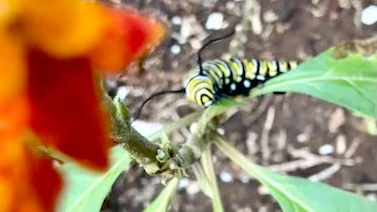
Soon after, the caterpillars appeared.
There was something in their colours—yellow, white, and black—and in their sharply defined stripes that suggested something beautiful could emerge from them. At least for those who know the secret of metamorphosis. Those who don’t might mistake them for a pest and wipe them out.
With nothing to fear, our caterpillars advanced and devoured. They ate the leaves of our new plant one by one, with meticulous care. They also consumed the pods, where seeds gather, each equipped with soft fibers that will one day carry them away on the wind.
I took my daughters to see them. We remembered that story we used to read again and again when they were little: The Very Hungry Caterpillar by Eric Carle. It eats strawberries, pears, Swiss cheese, chocolate cake. It grows and grows, almost to bursting. Then comes the stomach-ache. In the end, it chooses a leaf—the lighter option.
Ours, meanwhile, kept to their single, perfectly satisfying menu.
We stood there watching them, caught between complicity and fascination, as if the story had come to live in our own garden. A few days later, just as my father-in-law had predicted, one of the plants was reduced to bare stems. Then the leaves returned. The plant endures: it is, after all, designed to live with that loss.
Meanwhile, the chickens pecked through the garden in search of insects, leaving the caterpillars untouched. Leafcutter ants marched past and cut other nearby plants into pieces.
In a book I often consult, Plantas nativas para el control de la erosión, I found information about the plant. It goes by several names. Two are almost affectionate—bailarina (dancer) and algodoncillo (little cotton plant). Others are less kind: leche vaca, viborana, matacaballo.
“Leche vaca” is easy to explain: when the stem is cut, a white latex oozes out. But viborana and matacaballo hint at its effects on animals—those that recognize it and avoid it, if they can.
The plant produces compounds called cardenolides, which disrupt heart function. An effective defence—except for monarch caterpillars, which seem unfazed.
They don’t just feed on the plant—what I’ll call viborana—they also incorporate those compounds. And when they emerge as butterflies, that chemistry remains. Their colours—orange, black, and white—signal a warning: I am not a good idea.
The monarchs we see in Costa Rica do not arrive by chance: they seek out plants in this group, where they can lay their eggs. There are several species, but a single plant is enough to draw them in. Without those leaves, there are no caterpillars; without caterpillars, no butterflies.
In the northern part of the continent, this dependency drives them to travel thousands of kilometres when the cold erases these plants. Here, the movement is more subtle, but it follows the same logic.
A few months ago, some of our viboranas moved with us again—from Tres Ríos to Curridabat. And with them, the same thing happened once more: the monarchs arrived, and the caterpillars followed.
Today, the garden carries on. Thanks to the viboranas, butterflies cross the space, leaves come and go, caterpillars complete their cycle.
And when I see the plants stripped of leaves, I find myself happier. Happier still if someone were to come by and take one—or two—with them.