
Some nights, when I stayed over at my maternal grandmother’s house, she would recite a poem to me. She knew it by heart, never hesitating. Sometimes we would begin together and, before I noticed, her voice would continue on its own, with a cadence that seemed to come from another time: “Margarita, the sea is lovely, and the wind carries the delicate scent of orange blossoms; I feel a lark singing in my soul: your voice. Margarita, I am going to tell you a story.”
As I listened to those verses, I became Margarita, as so many little girls did. I travelled through fantastical palaces beside herds of elephants, and I saw a king draped in cloth-of-gold beneath a malachite gazebo. I would think then of the gazebos in our parks — often empty and silent — and try to imagine what one made of that beautiful-sounding material might look like. What was malachite? What was that thing made of the thing that seemed to exist only in poetry?
Rubén Darío wrote the poem of my childhood in 1908 for a real girl, Margarita Debayle, the daughter of friends in Nicaragua. By then he was already the great Spanish American modernist: traveller, reader of French symbolists, fascinated by colour and the music of language. Malachite belongs to that modernist universe of rare materials, gleaming minerals, and words that sound beautiful before they reveal their meaning. In Darío’s poetry, the stone is not geological matter, but poetic matter.
When I began my university studies, I discovered that malachite was even more beautiful than I had imagined. It is a green mineral crossed by concentric bands alternating between light and dark tones. A basic copper carbonate, it forms when copper alters and reacts with oxygen, water, and carbon dioxide. Similar processes also produce Verdigris and other greenish patinas on old copper and bronze objects: door handles, statues, and roofs weathered by time.
In Costa Rica, copper appears discreetly in nature, in small veins and mineralisations. It is found mainly in the south of the country, associated with the Talamanca Range and ancient hydrothermal systems linked to long-extinct volcanism. We do not have industrial-scale deposits or mining districts like those exploited in Chile or Peru.
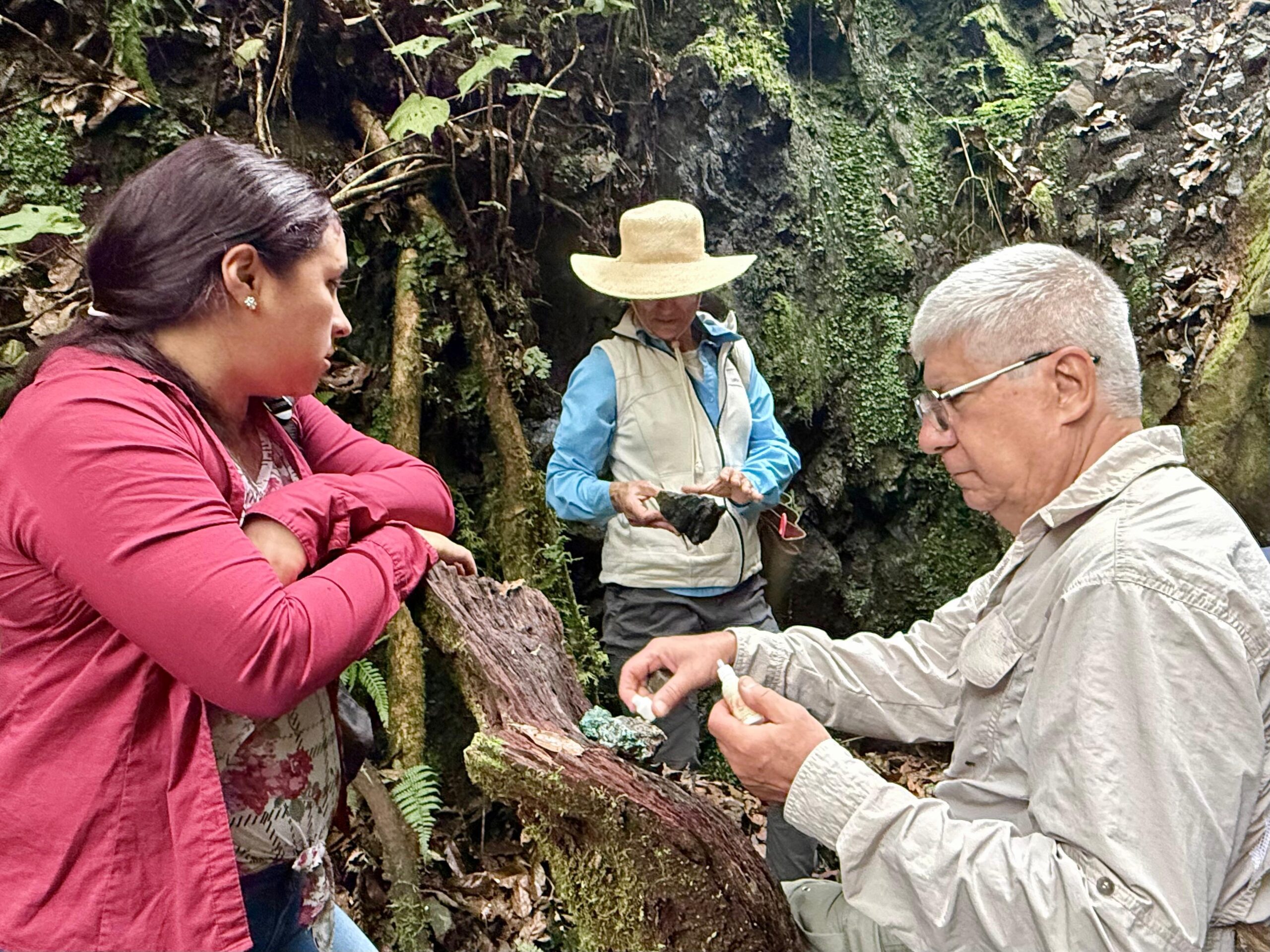
A few weeks ago, some colleagues and friends visited a copper mineralization at Cerro Boruca, near Cerro de la Muerte. It had been explored in the 1960s and 1970s but never mined.
The excursion began with gallo pinto and eggs at Doña Damaris’s roadside diner — an indispensable condition for any geological adventure — and continued with Magaly, her daughter, guiding us along a steep trail that did not seem entirely convinced it wanted to be a path. Between treacherous roots and loose stones shifting beneath our feet, we reached the mouth of the “mine,” far more modest than the word itself promises. It was little more than a small opening in the rock, yet enough to imagine stories of search, enthusiasm, and disappointment.
For those of us who appreciate local minerals, the place is a small treasure. We collected fragments of rock with malachite, azurite, altered chalcopyrite, and other minerals that promise no riches, but plenty of wonder. If malachite evokes dense foliage, azurite looks like a fragment of sky trapped inside the rock. Sometimes they grow together, creating combinations no designer could invent.
And so, I think perhaps that was what Darío intuited when he mentioned malachite in a poem for little girls: that some stones do not need technical explanations to be valuable. That certain minerals — like certain verses — matter not because of what can be extracted from them, but because of what they teach us. Darío does not write from above, but at Margarita’s level. He offers her a larger world.
And perhaps that is why, when I remember my grandmother reciting in the half-light, I understand that the true malachite gazebo was not in an imaginary palace or in a mine in Talamanca. It was in her voice, in that way she had of naming the world and making it brighter, wider.
She knew nothing of carbonates or chemical reactions, yet she taught me something geology would later confirm: that matter holds stories, and that wonder is itself a form of knowledge.
Malachite is still there, ancient and green, reminding me that whoever teaches us how to name the world also teaches us how to inhabit it differently.