
Sometimes, by accident, someone notices a shape, takes a photo, and raises the question: is it a bone or a piece of wood? A fossil or just another fragment of the landscape? The answer becomes a story—at least for those who know how to read the signs.
Along a stretch of the Aguacaliente River, in the Orosi Valley, the water flows as it always has. Or perhaps a little more. Cold fronts bring rain, as if unaware that it is supposed to be summer. The slope beside the site where excavation will soon begin seeps water without pause.
On January 16, the team arrives, assembled to explore the remains of a mastodon. It is led by geologist Joanna Méndez of the National Museum. Geologists, archaeologists, biologists, and palaeontologists come equipped with buckets, rubber boots, pickaxes—and the excitement of those about to unearth a treasure. They assume, with more optimism than accuracy, that they will be there only a few days.
Geologists read the texture of the sediment and, together with archaeologists, define the excavation area: an eight-square-meter rectangle, barely enough space for four people to work at once. The clay yields but embedded within it are small but stubborn rock fragments. Removing them takes time, and a wrong move could damage the bones.
Some pieces are protected with plaster, labelled, photographed, and carefully recorded. Because finding them is not enough—what matters is how each piece appears. In that precise arrangement, a story begins to emerge.
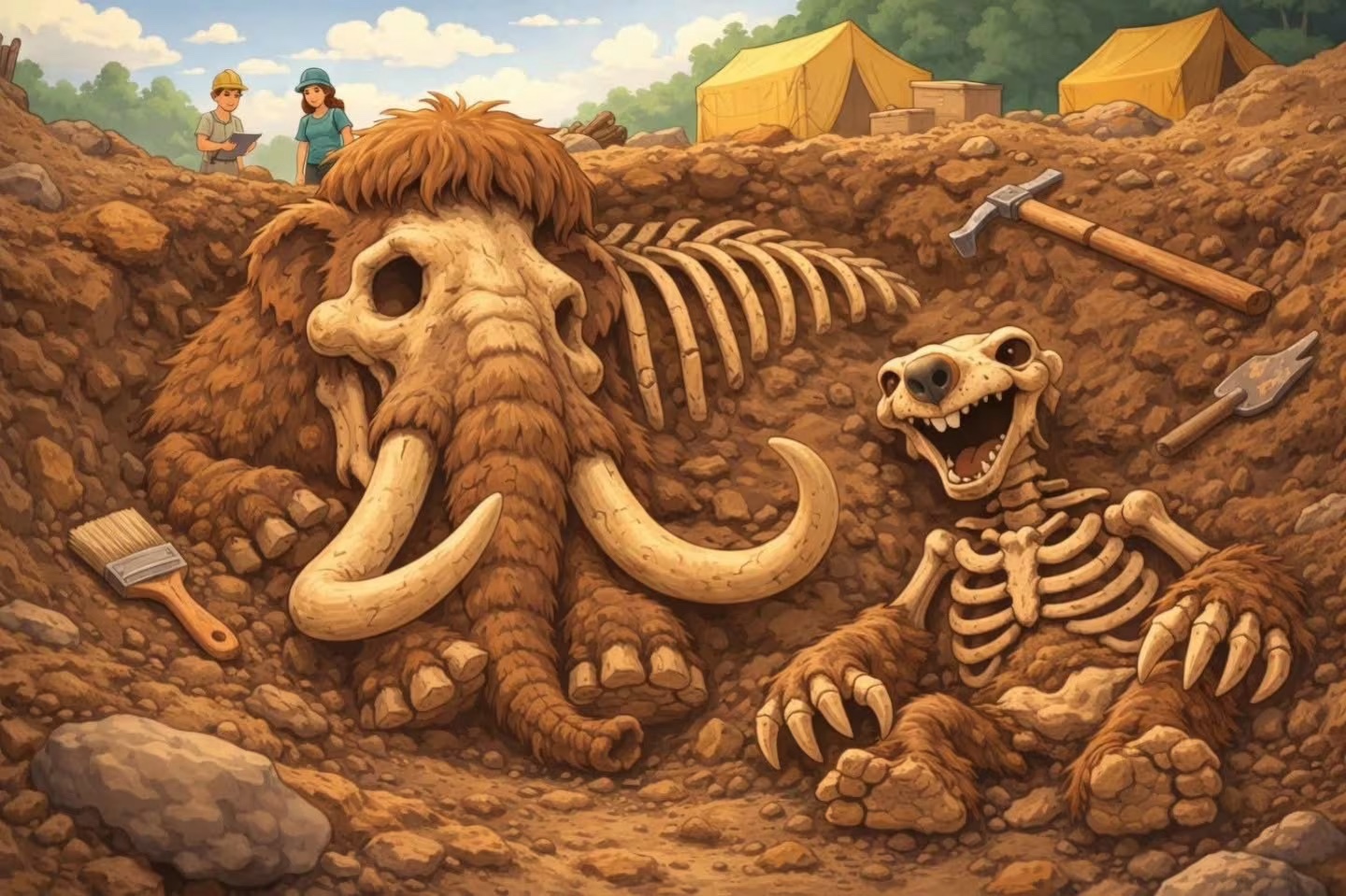
The bones of a Cuvieronius mastodon—named Pitan in honour of the young man who found it—sketch a scene slightly displaced from where the animal died some 13,400 years ago. They were buried in a swamp, among mud, pollen, and oak remains that today grow at higher elevations. These clues reveal that during the last glaciation, a colder forest once existed there.
In that landscape—at once familiar and different—moved a body weighing around three tons, with tusks more than two meters long, pushing its way through branches and mud. Pitan walked across terrain that is no longer the same. And it was not alone.
A thousand years earlier, downstream, lived a giant ground sloth, Eremotherium, named Tobi in honour of Tobías, the child who helped excavate it in December 2024. Its remains—dating back about 14,400 years—were found in sediments that point to a similar environment.
Tobi weighed around five tons; its body covered in fur. It moved slowly, using trees for support as it fed on leaves, tender branches, and shoots. It was hundreds of times heavier than today’s sloths. Dating confirms that Pitan and Tobi lived at different times, yet the mud preserved their bones by keeping them isolated from oxygen.
At the excavation site, the present keeps pressing in: the rain returns, the river rises. It is not only a matter of making progress, but of staying ahead; rescuing the pieces before the water erases everything. For twenty-three days, the team returns to the same spot, repeating small, deliberate actions that sustain an immense story.
One piece—a freshly unearthed tusk, saturated with water—weighs nearly one hundred kilograms. Removing it requires seven people, who move about three hundred meters along the riverbed, stepping over shifting stones that move just when you wish they wouldn’t. They go slowly, measuring each step. There is fatigue but also joy and a sense of shared purpose: the certainty that they are carrying something larger than the effort itself.
At the museum, the bones are cleaned, stabilised, and analysed. They are unique pieces that, together with field data, help reconstruct a landscape and understand this place when it was about five degrees cooler. They also allow these stories to be placed within a broader context—the arrival of the first humans, climate shifts, the disappearance of megafauna. They do not explain everything, but they assemble part of the puzzle.
Today, Pitan and Tobi move through our memes and social media. They have become our new mascots—the ones that arrived when we least expected them. Now, the megafauna of the Ice Age belongs to us as well; it represents us. It all began with a few traces in the mud of a river in Orosi—and with scientists who knew how to read them. To them we owe this return to a fascinating world that no longer exists: one inhabited by giants who were here long before us.