
Annaeus Serenus was a young man with many doubts, like almost all young people. He was neither consul nor general; he left behind no speeches or poems. And yet he stands out as an eloquent presence in On the Serenity of the Soul, the treatise Seneca wrote between the years 58 and 62 of our era.
Those were turbulent times. Nero reigned under the shadow of his mother Agrippina, and political life was a minefield of intrigues. Abundance coexisted with the threat of violence and the fear of conspiracies. In such a climate, to think about serenity was not an act of escape, but of resistance—an attempt to find within the soul the balance that seemed impossible outside it. Then, as in our own days, serenity was a scarce and urgent good.
Annaeus Serenus appears before us today with a double face. On the one hand, he is the historical figure we remember as a close disciple of Seneca. On the other, he is the symbol that guides those who seek a moment of repose amid the stridency of the world.
The night watchman
During the nights of the nineteenth century, when our cities were still lit by the trembling glow of oil or kerosene lamps, a discreet and steady figure walked the streets: the night watchman. With a ring of keys at his waist, a whistle around his neck, and a lantern in his hand, he was the guardian of calm and the sentinel of everyone’s sleep. His presence ensured that darkness would not become synonymous with danger, but with rest.
He lit the street lamps and announced the hour and the state of the weather with a cry that cut through the shadows: “Nine o’clock and all is serene!” Some, still awake, would answer with a prayer—“Hail Mary!” or “Praised be God!”—as if their words might also bring light into the night. He protected against fires, thefts, and misfortunes; he assisted the forgetful who returned late without their keys; and with his voice he marked a rhythm of safety in the midst of silence.
His name came from the way he announced the hour: “It is twelve o’clock and serene.” But the term extended beyond his trade. In some Latin American countries, like our own, sereno also refers to the light moisture that rests upon the grass at dawn. It is striking that the same word names both the night watchman and the gentle dew, as if vigilance and nature shared a single mission: to bring calm.
Today, with the arrival of electricity, the night watchman has faded into memory and become a nostalgic anecdote. Yet his figure endures as a symbol of the one who announces the hour, measures the pulse of time, and covers it with tranquility. Sometimes that care reappears where we least expect it.
The good contagion
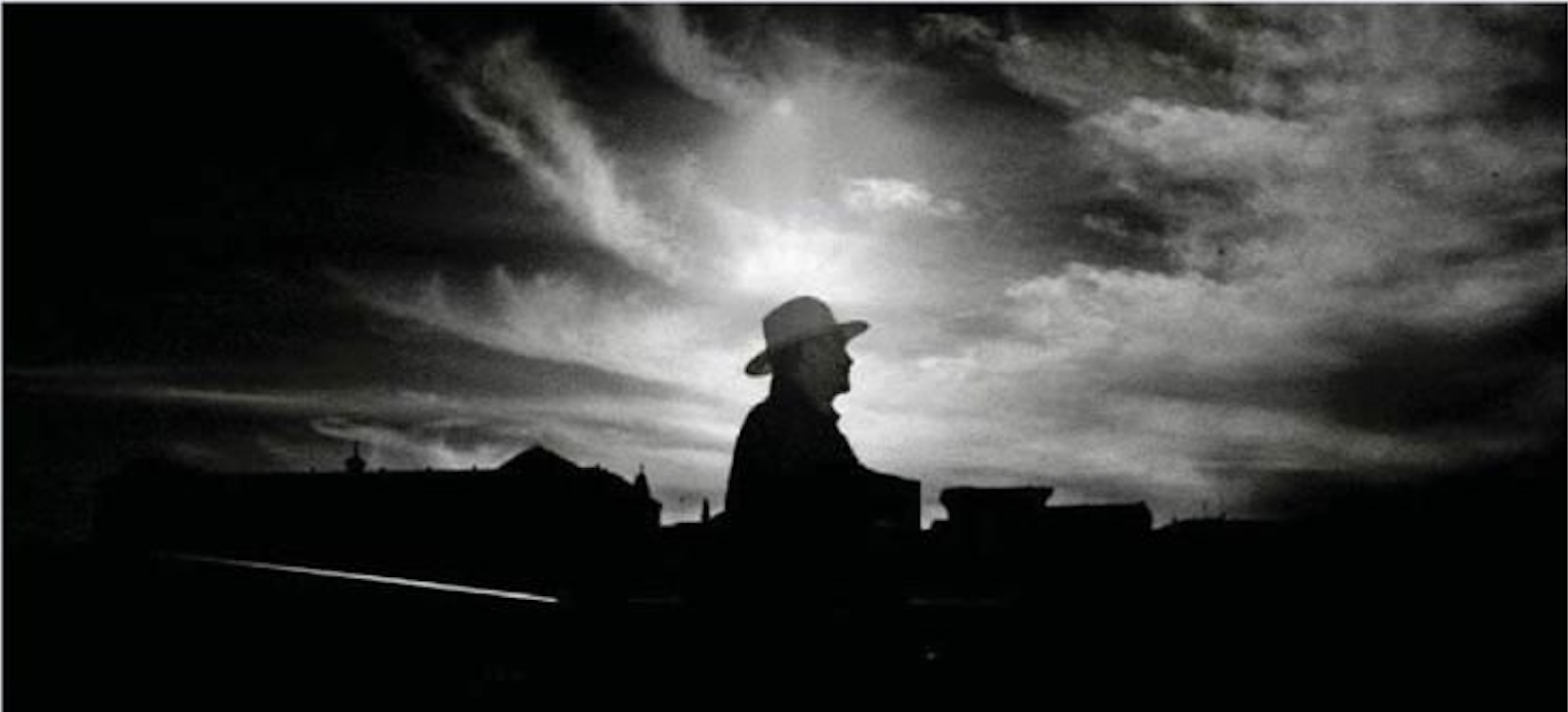
I travel to Toledo with my father. We cross the bridges over the Tagus and climb the Cuesta de los Escalones, famous for its steep incline. We continue to the lookout beside the Alcázar and rest there. I photograph him at the very moment when fatigue, satisfaction, and wandering thought come together. That balanced way of being—that gentle, generous presence I recognize in my father—is what I treasure most from our travels together.
Seneca taught us, as my father has taught me, that philosophy is not a dead letter, but the art of living calmly. That serenity does not arrive as a sudden gift, but as the careful cultivation of our relationships with our surroundings and with others. It is not the absence of problems, but a way of crossing the storm without shipwreck. It is not stillness without life, but balance in motion.
In days burdened by resentment turned into insult, in this age of anger we have been called to endure, the serene ones protect us from sudden changes of temper. They offer us the possibility of inhabiting the world with dignity and reveal themselves as protagonists of a good contagion. Like Seneca and his disciple, who sought clarity amid doubt. Like the night watchman in streets without electric light, who guarded collective calm with his lantern. Like my father, whose patient presence transforms fatigue into rest.
Serenity is not the exclusive privilege of Buddhist monks, nor an unattainable luxury for those of us who grapple with the accelerated rhythm of urban life. It is a way of being in the world that is learned with patience and transmitted with affection—practiced every day and, if we are fortunate, inherited. In that inheritance lies, perhaps, one of our greatest hopes.