
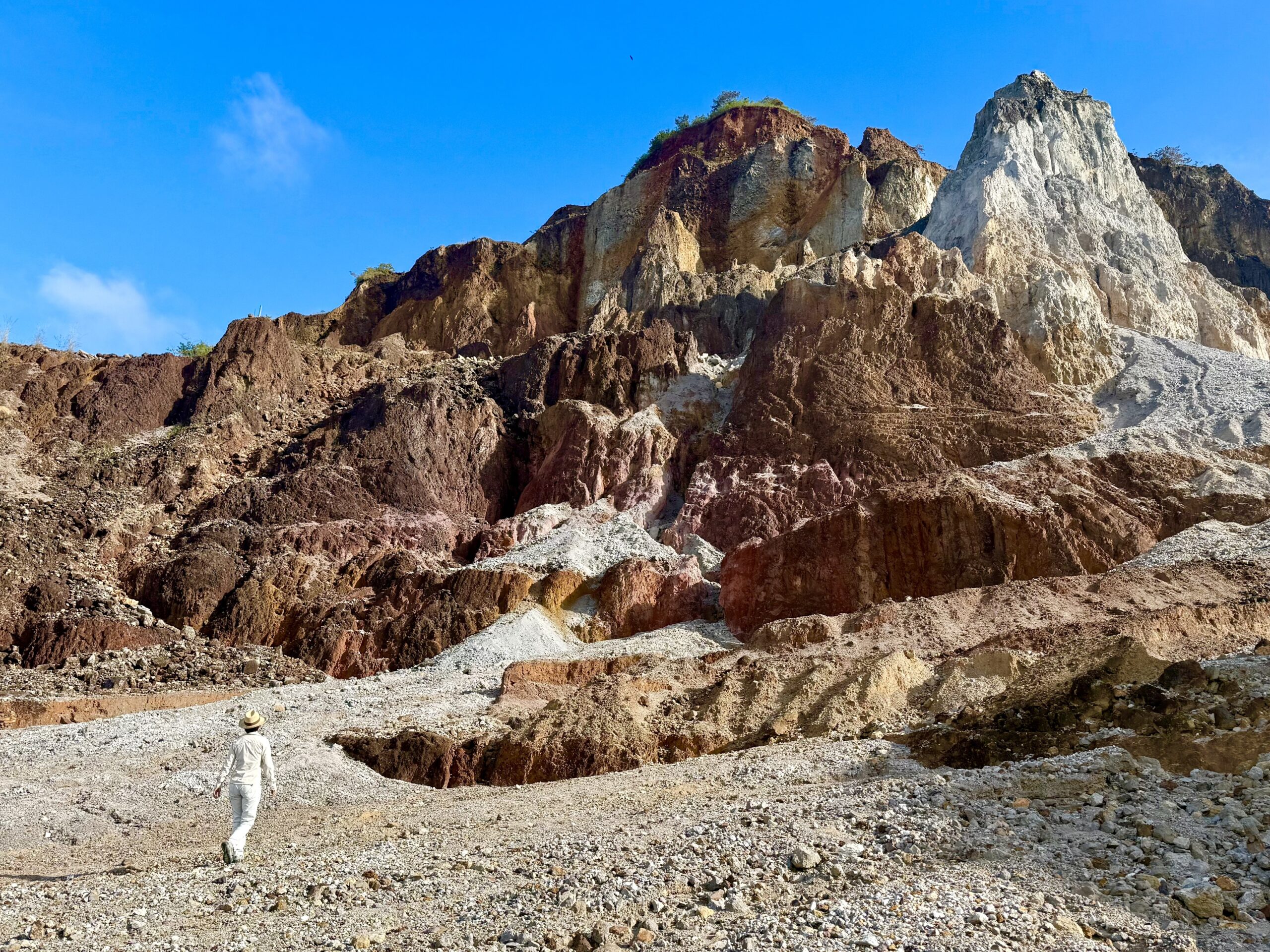
Some time ago, a friend made a remark — or rather, a provocation: “What do you mean you haven’t been to Tajo Zulay? It’s like going to Mars!” His words lingered. I added the site to my top ten geological places to visit — or revisit — knowing it had everything in its favor: it promised a kind of interplanetary journey. So one Sunday morning, we set out for San Pedro de Turrubares.At that hour — when the sun is still undecided about what to do with the day — the drive itself is therapy. As soon as you leave Route 27 and descend toward the Grande de Tárcoles River, the landscape shifts tempo. The city recedes and another Costa Rica appears: the unhurried version of San José province, with houses without bars on the windows, dew-covered pastures, and the occasional early riser already rocking on a chair out front. Everything moves, but in slow motion.Then the road bends, and there it is: a hill of stone, strange and colorful, as if someone had stripped it down to the bone and left it to cure in the sun, cracking its skin and carving deep grooves into its surface.A commanding silence descends from the escarpments. The ground is loose; as you walk, your steps sound like shattered glass. There are ochres and reds — the expected colors of oxidized iron. But there are also blues, lilacs, and pinks that seem impossible, as if someone had spilled a box of chalk across the hillside. The moment you step out of the car, you understand you have arrived somewhere foreign, even if it lies less than two hours from home.
Oxides and IridescenceBetween eight and three million years ago, this hill was not a quarry nor a Sunday excursion spot: it was part of an active volcanic landscape. The lavas and breccias that compose it lay near a heat source, which allowed hydrothermal fluids — very hot, mineral-laden waters — to circulate through its fractures. Over time, this process altered the rock from within and led to the deposition of metallic sulfides such as pyrite and chalcopyrite.Then came weathering: the quiet way the earth transforms itself when water, air, bacteria, and time work together. The more soluble elements that may have been present — copper, zinc, sulfur — were leached downward into deeper zones. What endured was a hard siliceous core, something like the minimum structure the hill chose to preserve, accompanied by iron oxides and hydroxides that remained at the surface.When iron oxidizes, it can turn ochre, red, or nearly black. But at this quarry something more unusual occurs. Under certain conditions — extremely thin mineral films, abrupt compositional changes, or microscopic cavities that scatter light — those oxides produce iridescence. Where you expect an earthy red, a blue appears; where a pale brown should be, a metallic pink emerges. And sometimes, when the sun strikes at just the right angle, flashes of gold or electric green surface.Geologists call this type of site a gossan, or iron cap. It is the visible trace of a system that was once hot and active — a mineral scar left exposed to the open air, determined to make itself noticed.
A Brilliant InvitationEntering Tajo Zulay feels like crossing a dimensional threshold: the rural landscape falls away and another planet appears — or at least a version of an alien planet in the heart of Turrubares. There is something profoundly restorative in that dislocation, in the surprise of encountering a place that compels you to fall silent and simply look.The silence here is not emptiness; it is an invitation. When hearing recedes, vision sharpens. What might happen if we looked at other things — other people, other landscapes — with the same curiosity with which we observe an iridescent rock? One is grateful that the country preserves these corners where time slows and the earth reveals itself without spectacle. The quarry’s silence — its solitude, its light, its improbable colors — asks only for our presence.Sometimes, keeping a list of geological places to visit allows us to reach other worlds. And it is enough to stand still before a mineral wall to understand that we are on Mars. The journey, in the end, is not about distance but about attention: about the way we look with wonder at what we once thought lifeless — and manage to see it begin to shine.