
In the early nineties, I was an apprentice projectionist at a small university cinema. The job had an obvious reward—the student scholarship—and others such as learning to thread film, watching the same scene six or seven times until discovering details that had previously escaped me, rescuing, now and then, a poster condemned to the trash.
That is how I got The Doors poster.
For a long time, on the wall of my room, Jim Morrison appeared consumed by fire, with the expression of someone who knows a secret. Beside it, a phrase attributed to the singer explained the band’s name and pointed toward mystery: “There are things known and things unknown. And in between are the doors.”
Later I read that the phrase was not Morrison’s. It came, long before, from William Blake and later Aldous Huxley, who titled one of his essays The Doors of Perception. That, however, matters little. What matters is that, after that phrase, doors ceased to be just any object.
Doors organize domestic life. They separate rooms, guard our dreams, contain conversations, mute noises, and mark the boundary between what is ours and what belongs to others. They also install enigma in everyday life. It is enough to walk through the neighborhood to verify this.
There are doors made of wrought iron, wood, or glass; rectangular or elliptical; with double locks, chains, or padlocks. All are different and yet share something: they raise questions about what happens behind them, about who leaves in the morning or returns at the end of the day.
In San José, there are many doors that keep a story: those of the old houses in Barrio Amón, with their colored stained glass; the metal ones downtown covered in graffiti; those of some soda shops that let the smell of freshly brewed coffee escape. Each one says something about what the city preserves and what it leaves behind.
Doors occupy a privileged place in myths and in our imagination because they transform space into a narrative. Crossing them can mark the beginning of a transformation.
In animated films, doors have come very far. In Monsters, Inc. they are almost a psychology manual. Thousands of doors aligned in a huge factory lead to children’s bedrooms. They are corridors in a literal sense, but also gateways to the most private territory that exists: fear. The movie reminds us that behind many childhood fears there are no monsters, but adults.
Long before that, there was Before the Law, Franz Kafka’s brief and devastating story. A man arrives at a door that leads to the law, and a guard tells him that he cannot enter—at least not yet. The man waits. He waits for years. He waits his whole life. When he is about to die, he discovers that the door had been destined only for him.
It is difficult to imagine a more precise fable about bureaucracy, freedom, and the limits we impose on ourselves every day. Sometimes no one blocks our way. Sometimes habit alone is enough to prevent us from crossing.
Popular culture, which rarely wastes a good image, has also not missed the potential of doors. Our grandparents warned: “An open door invites the good.” Today we say “house with open doors” to speak of hospitality, and we repeat that “when one door closes, another opens,” although we rarely know where the second is.
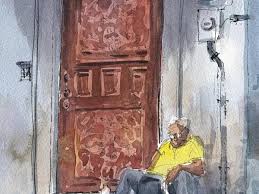
I have reflected on this when seeing the doors painted by José Pablo Ureña. In some of his pieces, an elderly person leans on a cane with one hand and holds a backpack between the legs. The elderly person seems to wait—or perhaps to think, or perhaps both, since they sometimes resemble each other.
Who is the elderly person waiting for? Who might open from the inside? A child? A grandchild? Did someone arrive too early? Did someone forget they had an appointment? Or does the appointment exist only in the imagination of the one who waits?
There appears once again the ancient mystery. Doors insinuate, suggest, leave clues, but never reveal everything. Perhaps that is why they keep on trembling. Because they are not just wood, hinges, and locks: they are a frontier between the uncertain and the familiar, between what happened and what could still happen, between inside and outside, between permission and prohibition, between fear and curiosity.
There are known things and unknown things. And in between, still, are doors. Some open and others refuse to do so. But almost all preserve the old talent of leaving us on the side of doubt.