
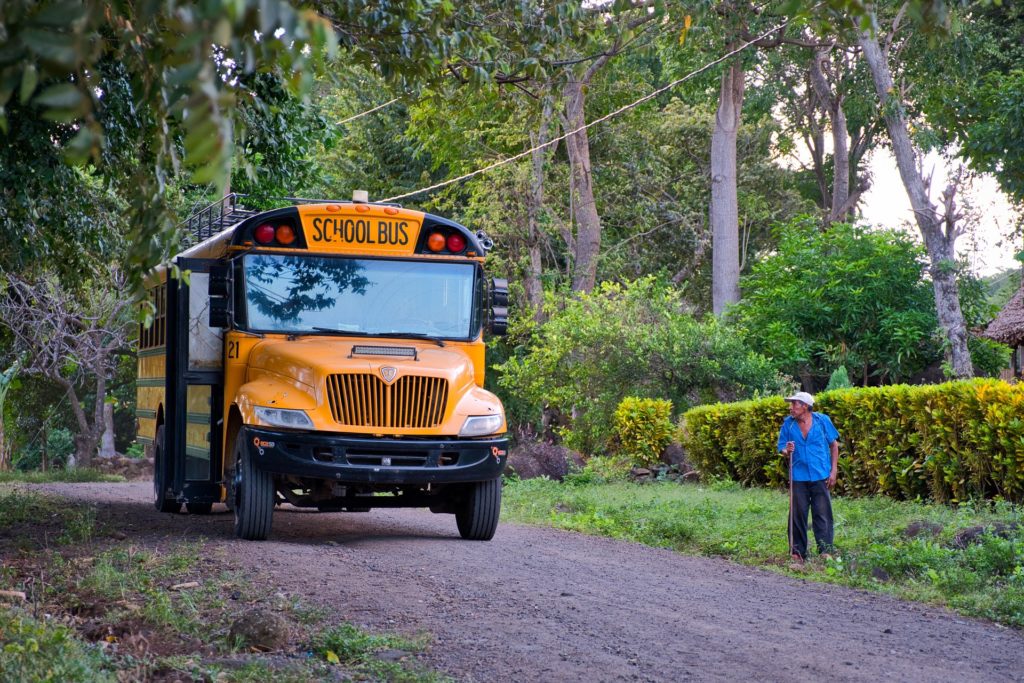
A bus waits in front of the gate. When the driver has not yet started the engine, the students get on laughing, swap seats and imagine the place they are going to. Every excursion begins like this, long before reaching the destination, with a mixture of enthusiasm and imagination.
This week, a news item published in La Nación took up a proposal announced by the President of the Republic during the press conference on July 1: to organize school excursions to the High Containment Center against Organized Crime, in La Reforma, so that young people know the consequences of crime.
Beyond its feasibility, the idea forces us to ask ourselves what we expect from a student excursion, and, in a broader sense, what places we decide to show to those who are beginning to discover the world.
Imagine that bus entering through the prison gates. Students descend in a row, observing the concrete walls, watchtowers, cells and mannequins in orange uniforms, while listening to explanations about disciplinary rules and security measures.
Then they return home with a lesson prepared by their rulers: this could happen to those who study in “dangerous neighborhoods of the country, where there are boys who believe that crime can be their lifestyle.”
There is no doubt that fear can produce obedience. However, it hardly produces citizens. Because educating from fear, or even from terror, means trusting more in punishment than in curiosity.
In the 1980s, with “The Dance of the Leftovers,” the Chilean group Los Presos denounced governments that promised social mobility but left many young people out of the system. In another of their songs, they used a phrase that is particularly valid today: “narrowness of heart”.
The expression reminds us that there is a petty way of living, educating and governing. One that tries to correct the behavior of young people without awakening in them the desire to explore the world.
Those of us who have crossed the border of our forties remember very different excursions. We visited museums, factories, nurseries, and movie theaters. We discovered that behind a cereal, a newspaper or a play there were people who did their work with patience and skill. These excursions broadened the horizon of what was possible instead of threatening punishment.
In the middle of the last century, the educator and musician Arnoldo Herrera summed up this idea in three words that still retain an extraordinary force: believe, create, grow. It was not just a school motto. It was, above all, a way of understanding education as an exercise in trust: believing in the abilities of each student, creating opportunities to develop them and grow together with others.
What if a software company hosted students from vulnerable communities once a month to show them how a software company works? programming equipment? Or if a baker taught them the craft of making bread before dawn? Or if a mechanic opened his workshop, a laboratory his microscopes and a sports club its training?
These excursions would not be warnings, but invitations. And it would not be necessary to have a program organized by the Ministry of Education to carry them out. It would be enough for some citizens to decide to open their doors, for one morning, to show what they know well.
A schoolboy who enters an architecture studio or a carpentry workshop for the first time does not only discover a trade. It also discovers a number of opportunities for the future.
In the end, educating consists of deciding where to direct the bus loaded with students. It can lead to a prison to teach fear or to tour workshops, laboratories, museums, and companies to arouse wonder.
A tour shows what a society fears; the other, what a society admires and considers worthy of building. There is much more than a pedagogical difference between the two trips. There is a different idea of the country.