
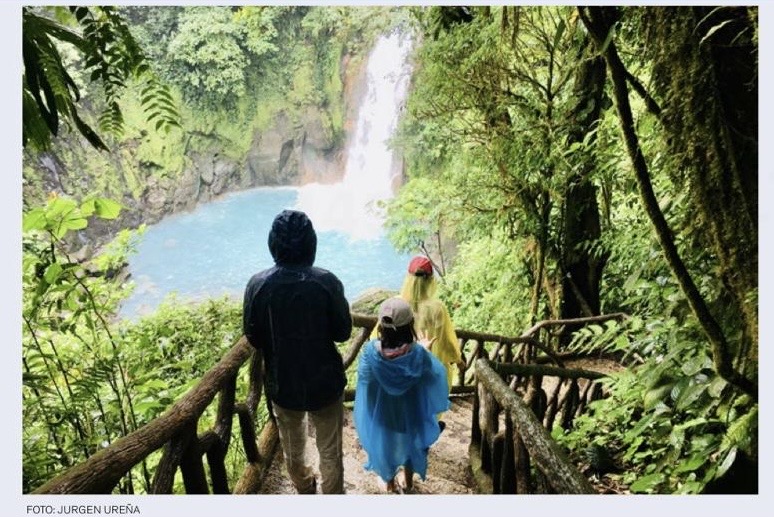
After several hours on the road, we reach Río Celeste, on the slopes of Tenorio Volcano. We protect ourselves from the downpour with plastic rain ponchos sold by some boys at the park entrance. The rain stirs up a smell of sulphur and wet tropics that fills the air. Ahead of us, a group of French tourists can’t seem to grasp how so much water can fall from the sky at once.
Soon we descend a steep staircase —the kind you already dread having to climb back up— leading to the waterfall, one of the park’s great attractions. Halfway down, the rain suddenly stops, and a shaft of sunlight breaks through, striking a pool as blue as my younger daughter’s raincoat. The colour is so unusual, so unlike any lake or stream we’ve ever seen, that the sight takes our breath away.
What minerals from deep inside the earth could have dissolved here to create such a hue? Could it be the influence of the volcanic terrain? And if the colour comes from volcanic rock, why does it appear in this river and not in others nearby? The climb back up feels lighter, driven by the excitement of reaching El Teñidero, the next great stop. Maybe there we’ll find an answer to the mystery of this blue.
The Magic of Río Celeste
We follow the trail along the clear waters of Quebrada Agria until it meets another transparent stream, the Buenavista River. Right there, the magic happens: the water, milky at first, turns blue just a few meters downstream. Two pristine currents merge and —as if someone had shaken an invisible flask— the colour changes before our eyes.
El Teñidero is an open-air laboratory. Nature invites us to watch closely, to ask questions, to linger a little longer before the mystery. In that pause something more than wonder begins: the need to understand, the impulse to look again.
Then, breaking the silence, my eldest daughter points to a sign beside the path. There’s the explanation: Quebrada Agria (“Bitter Creek”), true to its name, carries acidic water that, when it mixes with the nearly neutral water of the Buenavista, causes the tiny particles of silica and aluminium carried by both streams to clump together. As they react, the particles grow —from about 180 to roughly 560 nanometres across— to a size that changes the way light scatters through the water.
When sunlight strikes the river, those suspended particles selectively scatter the shorter wavelengths —the blues— in all directions. The result is an optical illusion: the river looks dyed, though it contains no blue pigment or mineral at all.
On the way back to the car, a blue morpho butterfly drifts across the trail. I recall something I once read: its blue, too, is not in the material, but in the way light touches it. On its wings, thousands of microscopic scales bend the light until only the blue remains.
Blue in Nature
The next morning, sunlight takes its time. It climbs slowly from behind the mountain, brushing the leaves with a pale shimmer. A hummingbird hovers over the fox-tail flowers. It seems blue. Or green. Or maybe turquoise? It’s impossible to tell for sure — its colour shifts with the angle of the light and with mine.
The blue from the day before still flutters in my mind. I investigate the origin of the hummingbird’s colour. Like the morpho and Río Celeste, this bird has no blue pigments at all: its feathers make the colour. Layers of keratin, air, and microscopic granules of pigment arrange themselves with the precision of a natural crystal; light enters, reflects, and recombines —some wavelengths amplify, others cancel out.
Curious, I search for other rivers where blue is born from light rather than matter. I find that there are several around the world —and even in Costa Rica, like the turquoise pools of Bajos del Toro— yet none with a confluence as theatrical and precise as El Teñidero, where two transparent waters turn blue the instant they touch.
I think of the blue of the river, the butterfly, the hummingbird. None of them exist in the substance itself; they are born of light and order. They are illusions that matter crafts to dazzle the eye. Perhaps that is why they draw us so deeply —because, as at El Teñidero, nature seems to pause time to perform its trick and remind us that curiosity —that need to look again— is the most luminous form of knowledge.