
A few weeks ago, we visited the National Museum with my nieces, Fátima, who is six, and Valentina, who is ten. We intentionally visited only part of it, hoping to leave them wanting to come back. Sometimes, less is more.
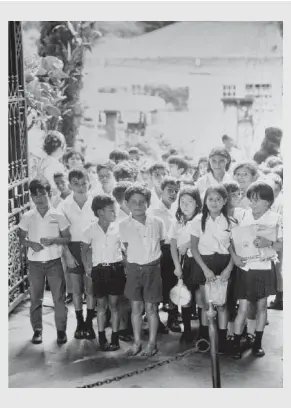
We stopped in front of a photograph taken in the 1970s, displayed in a room that once housed the old Bellavista Barracks prison cells. In the image, a group of schoolchildren waits in front of what was then the Museum’s entrance, on the eastern side of the building.
Some glance at the camera; others are distracted by their classmates. One girl carries a water bottle, another presses a plastic bag of school supplies against her chest. Perhaps she had forgotten that the class would be different that day.
At the center, in the foreground, a boy poses as best he can, with a spark in his eyes that seems to shine through the photograph. Perhaps it was his first visit to the Museum. Perhaps he was simply happy to be in front of the camera. I kept looking at him and noticed he was barefoot. I looked again from another angle. He was the only one.
In the San José of those years, it was unusual to see barefoot children, although these children may have come from a rural area. In any case, within that group, the barefoot boy stood out.
I remembered that inequality is not the same thing as difference. Economist Leonardo Garnier explained this in an episode of the podcast La Telaraña. Differences are part of who we are; inequality appears when those differences end up determining our opportunities. The task of education, he argued, is not to make us all the same, but to prevent differences from closing doors to us.
There stood the barefoot boy, waiting with the others to enter the Museum, perhaps with more excitement than anyone else. He was probably about the same age as my niece Valentina, who was looking at him just as I was. Those children had left the classroom, though not entirely the school: beyond that doorway, a world of new discoveries awaited them.
We continued on to the Commanders’ Houses, where my nieces came across Mauro Fernández. Or rather, that is how I introduced him. I told them he had been an ancestor of ours and one of the great reformers of Costa Rican education. At the end of the nineteenth century, he helped make public education a responsibility of the State.
Then I thought of my nephew Mauro, who had missed that Sunday outing. He lives in Guanacaste, and I see far less of him than I would like. One Mauro bears the other’s name, although time has piled generations between them: Don Mauro is his great-great-great-granduncle. To verify it, we all end up counting greats on our fingers.
Between one Mauro and the other lies more than a century. Yet so does much of the history of our public education system, which opened opportunities for many people and helped transform the country. But something became more complicated along the way: every time the ladder rises, it becomes harder to prevent some people from being left behind.
In another room, I found a text by my great-grandfather José Fidel Tristán Fernández, Mauro’s nephew. In Baratijas de Antaño (Trinkets of Yesteryear), my great-grandfather recalls the house of his uncle, which stood on that very site. He remembers the library, the gatherings, the corridors lined with orchids, and the view of San José. In one of those corridors, he wrote, “the air flowed in torrents.”
I stepped out into the corridor, although I knew it was not the original house, demolished long ago to build the barracks. I wanted to feel that air, to see the flowers again, to recover that view. I imagined the books, the conversations, the orchids. I imagined Don Mauro walking with his hat tilted back, which, they said, he used because it helped him think better. That place must have been magical.
By then, the walkway had filled with people: Fátima and Valentina, Mauro and Don Mauro, José Fidel, and that barefoot boy who, fifty years ago, stood waiting at the Museum doors.
The boy entered, left, and grew up. The photograph, however, froze him forever, barefoot, with that bright gaze.
Today he must be around sixty years old.
Perhaps he remembers the visit; perhaps not. I wonder what became of him, what became of the school that Don Mauro helped shape, and what other doors opened for him after that day.
Perhaps that boy now has grandchildren the same age he was then. Perhaps he occasionally takes them to a museum. I like to imagine that he has preserved something of that spark in his eyes—the spark that made me stop in front of the photograph on that Sunday when I did not want to.
I like to imagine that he found the time, over all these years, to light many other sparks.