
When I was a child, there was a stone in the garden of my home in Tres Ríos, set on a raised spot almost like a small sculpture. It was an angular, rather rough block, except for its upper surface, worn smooth and shaped by years of sharpening knives and machetes.
The stone stood beside a water tap so it could be kept wet. Every so often, the gardener would come over to sharpen his tools, and I would ask my mother to let me bring him the kitchen knives. It wasn’t the knives that interested me. I wanted to listen.
Some sounds lodge themselves in memory. Metal moving over wet stone made a sound that was earthy, slippery, repetitive. Stone, water, metal, over and over again.
That stone was called a molejón, or mollejón. That was all I knew.
Many years later, I discovered that my molejón belonged to the sandstones of the Coris Formation: sedimentary rocks that crop out around Coris, Patarrá, Tablazo and the hills of La Carpintera. Rich in quartz, a hard mineral highly resistant to wear, their surface is rough, “like a doormat made of bottle caps.”
In the sandstone, countless tiny quartz grains form an abrasive surface: draw a steel blade across them and they wear away the metal, restoring its edge. Water clears the surface. That sound I had loved so much was, in fact, the music of millions of grains at work.
To amolar is to sharpen a blade against stone. The word comes from muela: a millstone, something that grinds and wears away. But the molejón left an even more curious trace: a name written into the landscape.
In 1913, the naturalist Anastasio Alfaro wrote in the Boletín de Fomento that “molejón rocks” were abundant along the “camino de las amoladeras”—the road of the sharpening stones—southwest of La Carpintera, in Patarrá and Higuito.
There is something beautiful about the road’s name: it turns an everyday task into geography. We do not know exactly where it ran; there are a couple of possible routes, and the name seems to have vanished with time. Roads are rerouted, buried beneath asphalt, or slowly swallowed by the mountains.
The knives and the camino de las amoladeras belong only to the most recent chapter in the history of the molejón. Because before it was stone, the molejón was sand.
The rocks of Coris preserve traces of that origin: rounded grains, laminations and the marks left by organisms. In some of them, we geologists recognize shallow-water environments where waves, currents and storms stirred the seafloor. Elsewhere, plant matter was preserved even in layers of lignite, a type of coal.
More than eleven million years ago, those grains were sand on a Miocene coast. Long before they rubbed against the blades of knives, they had rubbed against one another beneath the waves.
In an earlier Letra Libre piece, titled The Sea That Returned, I wrote about how the limestones of Patarrá preserve traces of the tropical sea that once covered this region. Coris preserves another part of that landscape: sandy shores, shallow waters and places where plant matter accumulated.
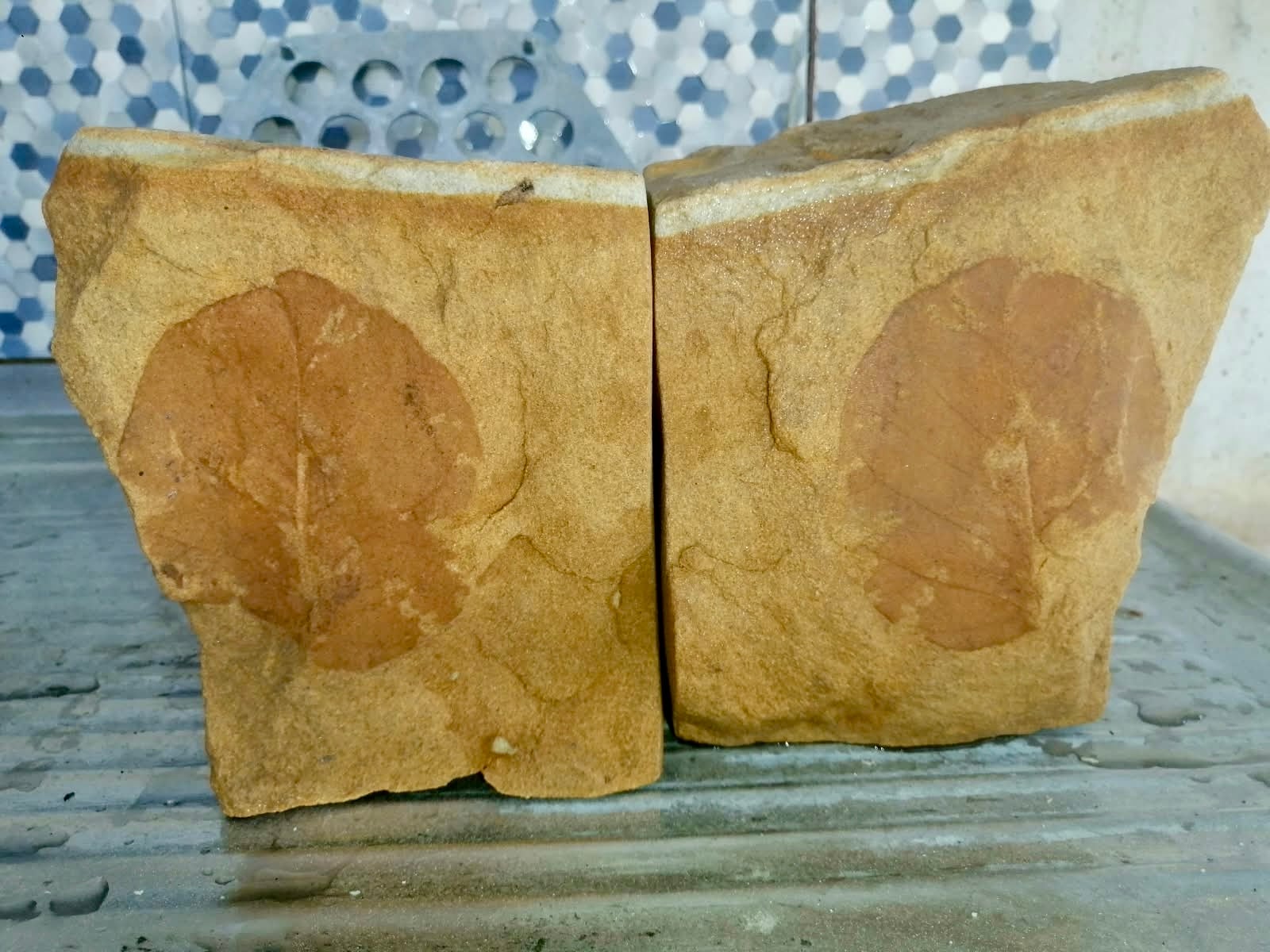
On one of those sandstone beds, the fossil impression of a leaf was preserved. Rock collector Luis Alejandro Gamboa found it in Patarrá about four years ago. A photograph of the fossil shows how the leaf left its imprint on both faces of a block that split precisely along the plane where it had been buried.
On a rough surface perfectly suited to wearing things away, the delicate outline of a leaf survived, along with some of its veins. An unusual occurrence on a beach churned by waves. A group of scientists recently studied the fossil and found a striking resemblance to the sea grape, also known locally as papaturro, although there is not enough information to assign it to that genus.
Years after finding it in Patarrá, Luis Alejandro took the fossil to a mineral fair, where it won the award for “Best Costa Rican Fossil” and caught the attention of specialists.
A few weeks ago, I was able to see it at Luis Alejandro’s home. He has collected rocks and minerals since childhood, always trying to discover where they come from and what stories they tell. The day after my visit, the fossil left his small museum at home for the National Museum, where it will be preserved for future generations.
Like Luis Alejandro and other people drawn to rocks and minerals, I too encountered these sandstones long before I knew what they were called.
Curiosity came first. Only much later came quartz, the Miocene and the Coris Formation. It had all begun in a garden, with music: the sound of a knife sliding across a wet molejón.