
A few nights ago, several friends came over for dinner. There was a long conversation, music, several bottles of wine, and moussaka, that Greek dish built in layers which, unlike rocks, takes hours to form and minutes to disappear.
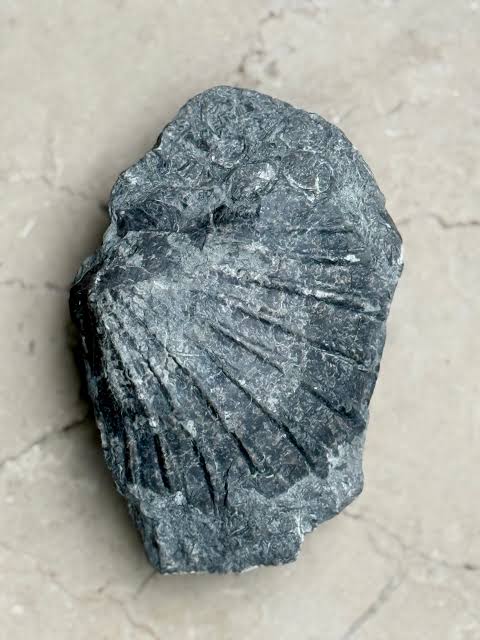
When they arrived, one of them handed me a small package. I opened it immediately. It was a stone. I held it up to the light almost instinctively. I turned it over, trying to guess where it had come from and what story it might hold. My friends smiled: they already know the effect these kinds of gifts have on me.
The story of the stone did not take long to reveal itself. It was a fragment of bluish-gray limestone from Patarrá, containing the perfectly preserved fossil of a bivalve mollusk.
The rest of the evening, it remained on the table, passed from hand to hand between one conversation and another. Questions soon began to emerge. Without anyone intending it, that fossil, more than ten million years old, became the most popular guest at the dinner table.
It was not the first time a rock from Patarrá had found its way into my home. Many years ago, during a university field trip to a quarry, I collected a block of this limestone. It was larger than prudence would have recommended carrying, but geologists have always had an optimistic relationship with the weight of rocks.
For years, it occupied a corner of the house until it disappeared. Surely, it ended up in good hands, as good books often do.
In a couple of weeks, I will return to that quarry with a small group of friends. Luis Alejandro, a relative of its owners, will allow us to explore it. We will walk slowly, observe, and let the rocks speak to us.
That same night, after everyone had left and the house had returned to silence, I opened a few scientific papers. I wanted to remember the age of those limestones, reconstruct the environment in which they had formed, and reread a story I had studied long ago and which, nevertheless, continued to evoke the same sense of wonder in me.
Millions of years ago, during the Miocene, there were no neighborhoods, roads, or coffee plantations where Patarrá is located today. The territory that would eventually become Costa Rica was part of a group of volcanic islands. The Central American Isthmus did not yet exist as we know it, and the Caribbean and Pacific were still freely connected. That is what we can reconstruct today from the rocks.
Around those islands stretched tropical seas, warm and shallow, with very clear waters. Sunlight easily reached the seafloor, fostering an extraordinary abundance of life. All kinds of mollusks thrived among calcareous algae. Many were bivalves, animals that protected themselves with two shells, like modern clams. Some of those species disappeared; others still have living relatives in our seas.
When they died, their shells began to accumulate on the seafloor, forming thick deposits of calcium carbonate that, over time, under pressure and through the chemistry of the Earth, eventually became rock.
Thus, the limestones of Patarrá are, quite literally, the bottom of an ancient sea.
As the volcanic arc continued to evolve, tectonic forces folded and uplifted those marine layers. The bottom of that sea eventually became a mountain.
Every fossil found in these limestones is a small piece of evidence of that transformation. It does not speak only of an animal that once existed. It speaks of an entirely different country.
What I like about fossils is that they force us to question the apparent permanence of landscapes. They remind us that continents move, oceans disappear, mountain ranges rise, and the world changes at a pace that human life cannot perceive.
Very close to my home, in Los Diques de Pinares Park, there is a small wall covered precisely with these limestones. I suspect that whoever placed them there was simply looking for an attractive stone. Yet all it takes is a closer look to discover fossilized shells embedded in the rock.
Every time I walk by, I slow down. The wall marks the boundary of the park and helps support the terrain. But it also reminds me that, beneath our feet, we can still find the bottom of an ancient sea. A sea that returned.