
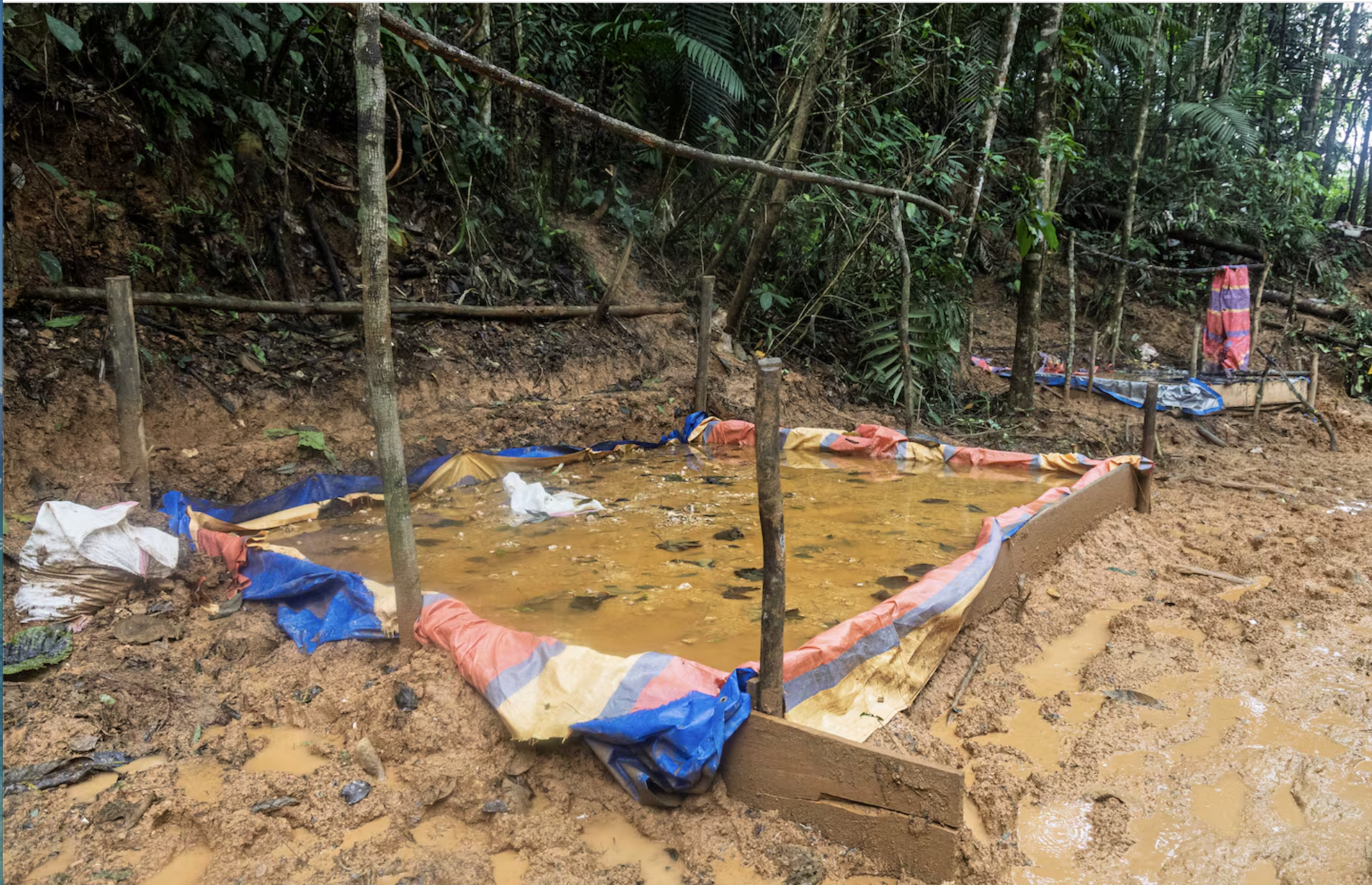
In Costa Rica, the word mining can quickly raise the temperature of any conversation. Merely mentioning it is enough to push people into opposing camps. Yet what is happening in Crucitas today should prompt us to reflect beyond the familiar debate of whether mining is simply something to support or oppose.
What is urgently needed is to stop the damage that continues to occur in the region. For years, informal gold extraction has disturbed soils, altered waterways, and fragmented forests. Mercury remains one of the principal environmental concerns in and around Crucitas. At the same time, however, there is still a lack of comprehensive studies that would allow us to fully understand the distribution and risks associated with the substances used in gold extraction, including cyanide.
Meanwhile, high gold prices create economic incentives that are extraordinarily difficult to ignore. This points to an uncomfortable reality: prohibiting an activity also requires having the actual capacity to enforce that prohibition over time. Where economic incentives are strong and territorial oversight is limited, a legal ban alone is unlikely to prevent ongoing environmental and social degradation.
It is within this context that Bill No. 24,717 has emerged, proposing to authorize industrial metallic mining in Cutris. Given the political support behind the initiative, it appears increasingly likely that it could move forward. Precisely for that reason, it is worth discussing now the aspects that should be strengthened to ensure more effective remediation, environmental monitoring, and oversight in the region.
The first issue concerns the scope of environmental recovery. The bill establishes rehabilitation obligations for the concession holder, but it leaves open a fundamental question: how far should this recovery effort extend in light of the cumulative impacts caused by years of informal mining? After all, stabilizing a mining site is not the same as remediating a landscape already affected by contamination, altered hydrology, and the loss of ecological functions.
The second discussion relates to the areas that may remain outside the mining concession. There is still limited understanding of the actual extent of land affected by informal mining in Crucitas, and some of the most degraded areas may not coincide with the zones of interest for future industrial extraction. The bill assigns the Ministry of Environment and Energy (MINAE) responsibility for preparing assessments and restoration plans for such areas, raising an unavoidable question about the technical capacity and financial resources required to sustain remediation efforts over many years—or even decades.
The third issue concerns environmental standards and the practical ability to enforce them. The bill refers to the use of “international best practices,” but it leaves open the question of which standards should be adopted and how compliance would be guaranteed. International mining already has widely recognized frameworks—such as the IFC Performance Standards, IRMA, and the Global Industry Standard on Tailings Management—that provide clear benchmarks. Adopting such standards is important, but equally important is ensuring that institutions have the capacity to implement and enforce them effectively.
If Costa Rica decides to move forward with metallic mining in Crucitas, the debate should focus on how to transform that decision into a genuine opportunity for territorial restoration and for generating lasting benefits for both the region and the country. This would require using the process not only to address a severely degraded landscape, but also to strengthen environmental governance and institutional capacity.
This is precisely why the design of the concession award process will be especially important. The bill proposes a public mining auction in which the royalty percentage offered to the State would play a central role in evaluating bids, provided that the established technical, legal, and environmental requirements are met. The challenge will be to ensure that territorial restoration occupies a place that is just as visible, rigorous, and enforceable as the economic criteria used to select the concession holder.
If these issues are addressed clearly from the outset, mining in Crucitas could become something more than an extractive activity. It could become an opportunity to ensure that territorial restoration is no longer treated as a secondary objective but rather becomes the central principle guiding decisions about the future of Crucitas.