
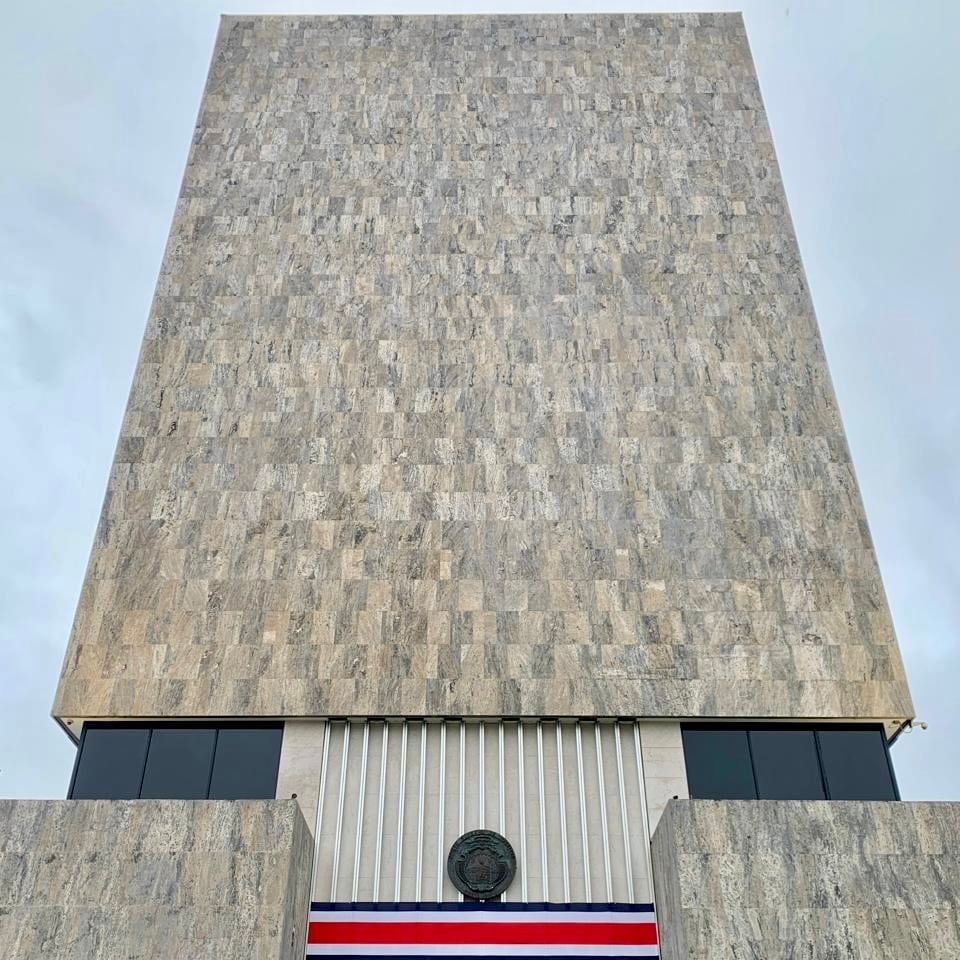
Our Supreme Court is clad in a stone that was born from water.
It has been so since the building opened its doors in 1966.
This rock, known as travertine, ranges in color from gray to cream and pink, marked by veins and irregularities. Before arriving in San José, it was formed in Navarro del Socorro, Cartago.
Travertine belongs to the limestone family, although it forms in a different way. It is not born on the seafloor, but on land. Water circulates underground, collects carbonate from rocks and, when it returns to the surface, deposits it.
It works with whatever it finds at hand: a stone, a branch, a leaf. It coats them and grows around them. Later, the branch or leaf may disappear, but its shape remains imprinted. In this way, a porous, irregular rock emerges, full of cavities and whimsical forms.
In Navarro, carbonate is close to the surface. There, the limestones of the San Miguel Formation outcrop, having formed beneath an ancient sea more than ten million years ago. Travertine came much later. Water passed through those limestones, absorbed some of their carbonate, and returned it transformed into new stone. It is something like recycling a sea.
To find travertine, one must descend. From Cartago, the road sinks between increasingly steep slopes. More than entering a valley, it feels as though one is being submerged into it. At the bottom flow the Navarro and Perlas rivers.
Beneath that landscape runs the Navarro fault system. Its fractures shape the valley and open pathways that allow water to descend, warm up, and rise again as thermal water. The mountain is fractured, and water knows how to take advantage of the cracks.
In the book Las aguas minerales y termales de Costa Rica (Mineral and Thermal Waters of Costa Rica), edited by geologist Guillermo Alvarado, these waters are mapped from Agua Caliente and El Guarco to Orosi, the Perlas River, and Navarro.
Around 1860, naturalist Alexander von Frantzius described a zigzagging path that descended to the valley floor. Near the river, he found a warm spring that left calcareous sediments in its wake. He also described large travertine deposits and, on the opposite side, limestones containing marine fossils. The two rocks stood there, facing each other.
A few weeks ago, we followed that path to the farm of some friends in Navarro del Socorro, near the Perlas River. Amid the vegetation, an enormous wall of travertine appeared.
The place was a small valley within the valley. The wall rose several meters high, and vegetation had reclaimed it. Mosses, ferns, and bromeliads grew on the rock; extraordinarily long roots descended from above. Shafts of light filtered between the blocks and, in some corners, small stalactites hung down. It felt like an open cave in the middle of a garden.
We began searching for shapes in the stone. First, we found leaves. Their outlines remained visible, and in some cases even the veins could still be seen. Then we noticed small tubes and started guessing what had once been there: a twig, a stem, perhaps a root. Minerals may have grown around it while the organic matter disappeared, leaving only a hollow behind. The stone preserved the shape of what was no longer there.
As we were told, very close to that spot stood the quarry from which the Court’s travertine likely originated. Extracted and cut into slabs, it left the floor of Navarro, climbed to the plateau, and eventually reached San José.
Sixty years later, it still clothes one of the Judicial Branch’s main buildings. From afar, the differences in tone give movement to the façade. Up close, those differences multiply. The slabs vary in color, the veins are interrupted, and the surface preserves the marks of a rock born full of pores and cavities. To use it as a facing material, the surface voids were filled. Even so, much remains of the whimsical stone we saw in Navarro.
The travertine was adapted, yet it never ceased to resemble itself. Perhaps therein lies its beauty. Water advanced, surrounded leaves and branches, deposited carbonate, and left behind empty spaces as well. It was never perfect. Nor did it need to be in order to be installed on the Court building. There it remains, six decades later, with its differences and its scars still recognizable.
Sometimes we mistake imperfections for evidence that something has ceased to be useful. We have become accustomed to viewing imperfection with too much impatience: the imperfections of democracy, public health, or the judicial system.
The Court’s travertine suggests another possibility: some things can be irregular, show the passage of time, and require repairs without needing to be replaced.