
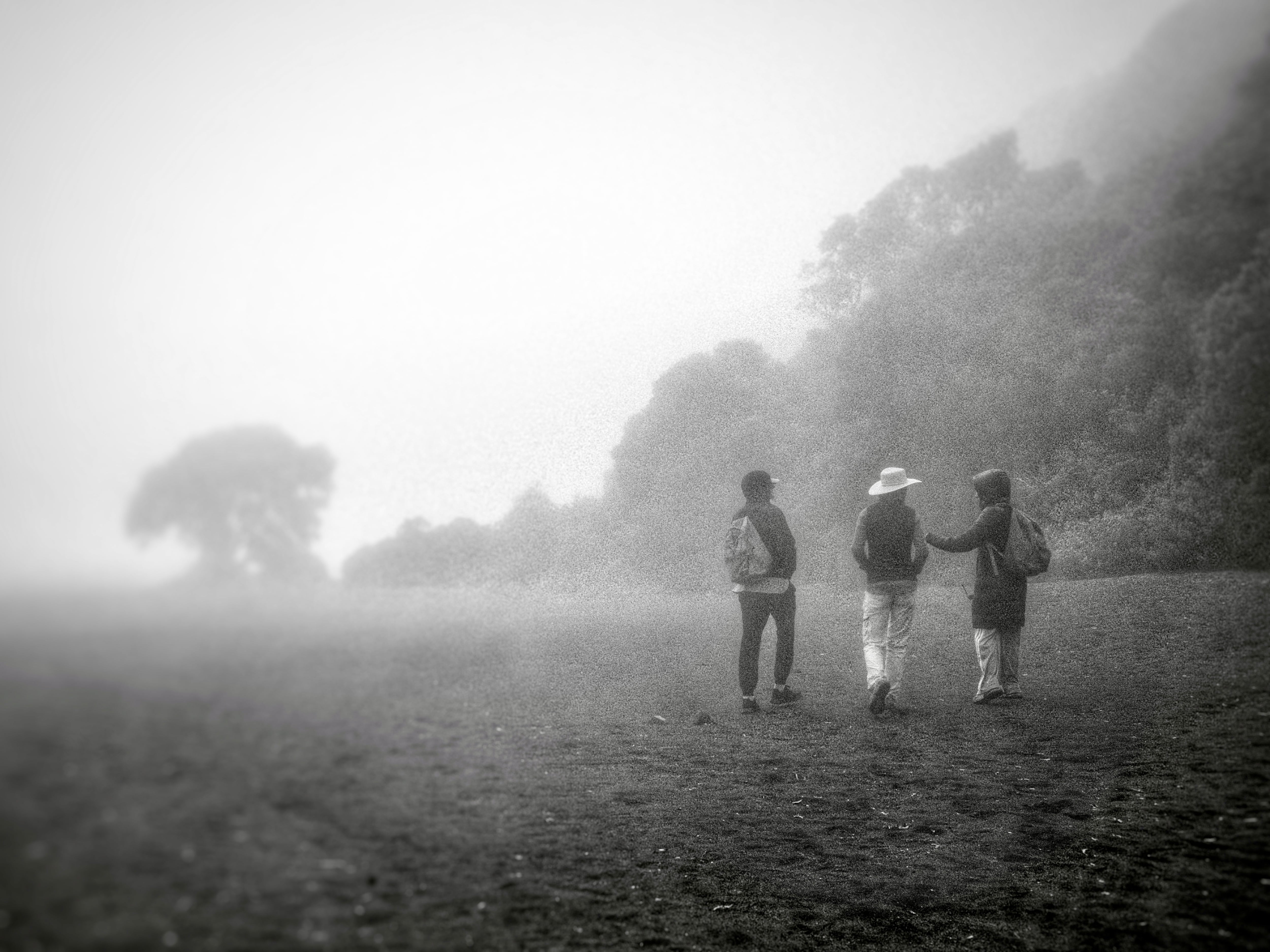
In the early 1980s, when I visited my aunt Yolanda’s house, Cartago was the city of mists. People did not call it that then. That came later. Back then, chilly afternoons arrived wrapped in a veil of vapor that softened everything: the streets, the buses, the cyclists, the train station, and the park of ruins.
A few days ago, I traveled to the foothills of Irazú Volcano and remembered that city that always seemed on the verge of disappearing, yet never quite did. There, the landscape pleases the eye with lines that suggest forests and horizons. You think you can make something out among the trees, but you can never be completely certain. Imagination fills in what is missing.
“Mist is the dream of water, dissolving into a light gray,” wrote the Mexican poet Amado Nervo at the beginning of the twentieth century. In that phrase, water becomes a dream, taking on a form we can barely recognize before transforming into something we do not quite know how to name.
It is curious that we have come to regard sharpness as a virtue in itself. Screens improve their resolution, cameras increase their pixel count, and phones offer photographs capable of capturing the smallest detail. It is as if the world were obliged to present itself with perfectly defined outlines. As though understanding consisted of eliminating all doubt.
Yet some things are seen better when they are not seen completely. A silhouette can awaken more curiosity than a detailed portrait. Some memories lose much of their charm if we succeed in reconstructing them with total precision.
Mist reminds us that not everything needs to be perfectly defined in order to be recognizable. Sometimes a suggestion is enough.
We often confuse mist with fog, although fog is denser and significantly reduces visibility. If mist allows the world to peek through, fog makes it disappear. One is a suggestion; the other, a kind of magic.
Mist also has more modest applications. In an auto body shop, a fresh coat of paint must blend into the surrounding finish until the repair no longer draws attention. In a hair salon, a haircut softens differences in hair length. Painters blend tones and diffuse contours so that a flat surface appears to have depth. In all these cases, the goal is to soften transitions, just as mist does so well.
In ancient Greece, those who consulted the Oracle of Delphi hoped to obtain answers about things that had not yet happened. But the answers were ambiguous, and interpreting them required additional effort. The oracle always spoke in a misty manner, through metaphors, and whoever sought its guidance had to make sense of what they had heard.
We are not so far from Delphi as we might think. We too want to know what is going to happen, what a half-heard phrase means, or whether a coincidence is really just a coincidence. Some people look for winning lottery numbers in plant patterns; others find messages in dreams or hidden threads connecting events that appear unrelated.
As I write this, No te espero, by the band Hijos, is playing on my computer. The song was written by Pablo Rojas, who is not only a friend of mine but also comes from Cartago. In other words, a son of the mist.
No te espero lasts three minutes and seventeen seconds—just enough time for a voice to leave a few things suspended in the air. The song speaks of a farewell that has been announced and of a wait that may be coming to an end.
As I listen, the words take on new meanings. The same phrase can first sound like resignation, then freedom, and later defeat and clarity. I suspect there is a certain lucidity in that movement.
I think of music’s ability to preserve an emotion that moves along with us. I think of the Cartago of my childhood. I am no longer sure whether I remember it exactly as it was or whether, over the years, I have blended into that memory other cities and other cold afternoons.
Perhaps that is why we speak of mists more often when memories begin to fail. Perhaps the streets were not really covered in mist as often as I like to imagine, and perhaps the park of ruins was never quite on the verge of vanishing.