
In the early nineties, I was a projectionist at one of the University of Costa Rica’s cinemas that offered a second life to films. In those days, amid beams of light and rolls of celluloid, I received some of the best lessons I remember.
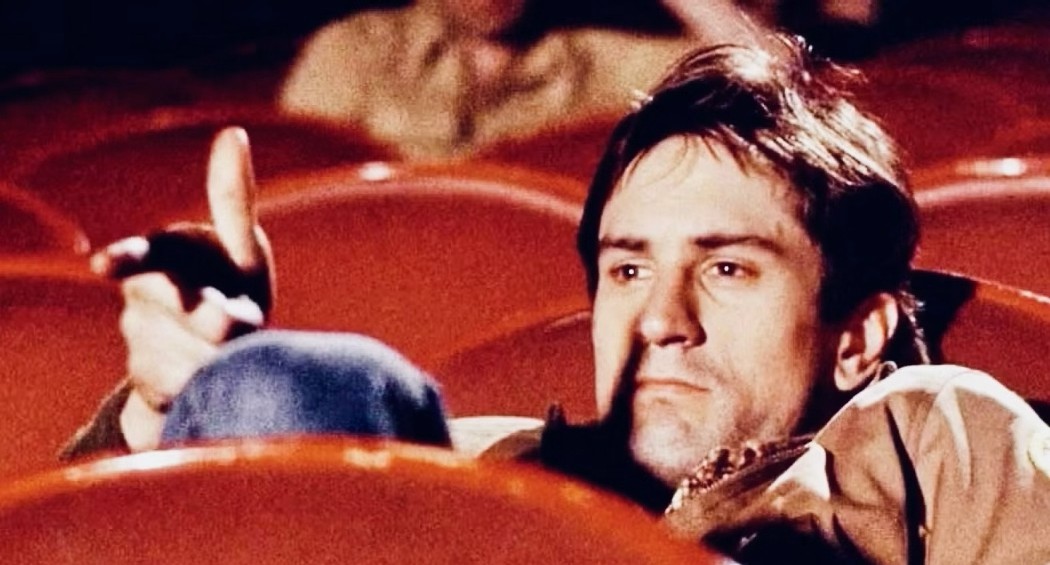
That is how Taxi Driver appeared. After watching it several times, a gesture stuck in my mind: the protagonist, Travis Bickle, would raise his hand, fold his thumb, and use his index finger as the barrel of a revolver.
Travis was an isolated man. He drove his cab at night to combat insomnia and sought conversations that never quite happened. Little by little, he began to imagine that the world needed a redeemer and that he could become one. His imaginary weapon was a desperate way of intervening in a reality he could not understand.
In Taxi Driver, that gesture appears three times. First at the cinema, when Travis points at the screen. Later, in front of the mirror, while holding a real gun in his hands and pointing at his own reflection. Toward the end, when violence has consumed the story, the finger with which he simulates shooting himself reappears as a sign of exhaustion and emotional disorder.
Some films gift us with questions that, years later, we still cannot answer. Taxi Driver is one of them. When was the last truly peaceful day in Travis’s life? When did he stop pointing outward and start pointing at himself? At what point did he stop conversing with the world and begin arguing with his own reflection?
The story of John Hinckley Jr. suggests that some of those questions remain within viewers as deformed experiences. In 1981, Hinckley attempted to assassinate President Ronald Reagan after developing an obsessive fixation on Taxi Driver and actress Jodie Foster. During the trial, the film was used as part of the analysis of his psychological state.
Thinking about Travis’s revolver finger leads us to wonder what would have happened if Hinckley had found a support network before turning his frustration into a destructive fantasy. The question leads the conversation toward the importance of prevention and care.
Half a century after the premiere of Taxi Driver, Travis’s repeated gesture still places us in an uncomfortable spot, showing us how isolation, a lack of bonds, and emotional deterioration can warp a person’s perception to the point of making them believe violence is the only way out.
In Costa Rica, we continue to talk about mental health only when the crisis has already happened. When lost conversations and small renunciations have already done their work. As if we could only react to the sound of the gunshot, but not to the rituals that precede it.
Important efforts are being made by the Costa Rican Social Security Fund (CCSS) and various public institutions, but clear challenges also persist: long waiting lists, a shortage of specialists, the concentration of services in urban areas, and insufficient coordination between medical care, community support, and family accompaniment.
During the time I worked as a projectionist, I learned that a film can break because of a poorly cut frame. It only takes a tiny bit of damage for the film to stop moving forward normally and for the light to end up consuming everything. I suspect that the frame that began to burn first in Travis’s life was Vietnam.
If so, that is barely a trauma. Just one of many. In that delicate balance we call life, the broken frame could be anything.
Today, Travis’s revolver finger is not only a symbol of violence; it is also a warning sign about the need for support systems capable of intervening preventively.
A few days away from commemorating World Mental Health Day on October 10th, Travis’s imaginary shot reminds us of the importance of recognizing suffering before it turns into a crisis.
Perhaps that is the most relevant lesson of Taxi Driver.
The real danger does not lie on a movie theater screen, but in the inability to recognize other people’s pain in time. When a society ignores the mental health of its citizens, an imaginary bullet begins to travel the long road from isolation to violence.