
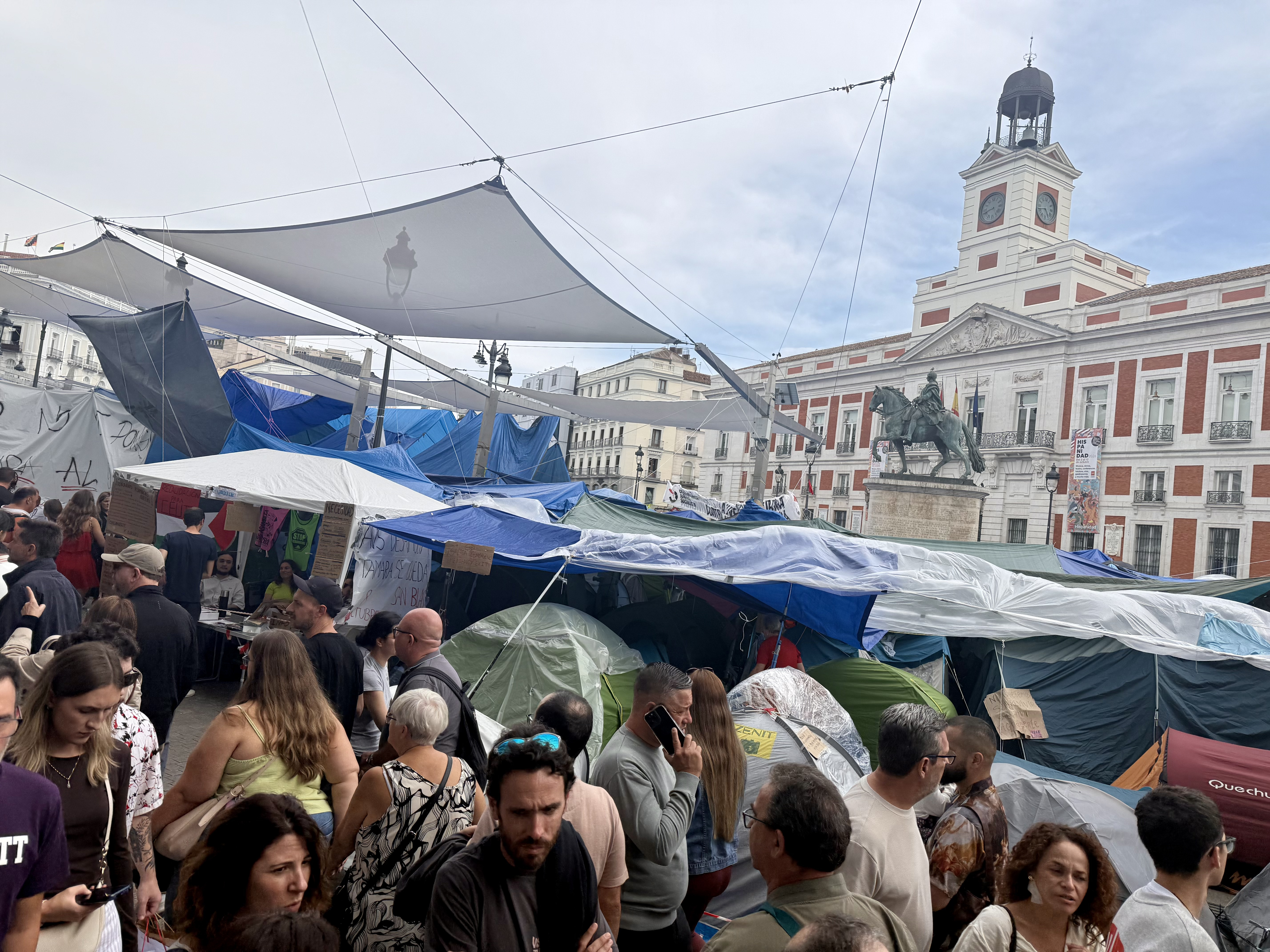
In Madrid’s Puerta del Sol, a tropical downpour had flooded the pavement. Large white tarps, stretched with ropes, covered the tents. Beneath the blue and green canvas sheets, hand-painted signs and groups of people formed a small, improvised community. In the background stood the clock tower and the equestrian statue of Charles III. There, people protested unaffordable housing, evictions, and real estate speculation. Tourists continued weaving around puddles, largely detached from that other Madrid.
During our trip through Spain, protests crossed our path in all three cities we visited. In Valencia, streets were closed and police redirected traffic. In Madrid, there was the encampment. In Barcelona, a march moved forward accompanied by chants. Later, the news helped us understand the causes behind them. We also read about French students protesting overcrowded classrooms and deteriorating schools.
An 87-year-old woman facing the loss of her home, young people working without achieving independence, students demanding a dignified school. Different stories, connected by the same question: what room remains for building a life when profitability carries more weight than human needs?
I thought about our daughters, who are about to finish high school. They have received a good education and opportunities that many young people do not have. Yet they too wonder what to study when professions are changing so rapidly, where they will be able to build a life, and what kind of planet they will find thirty years from now.
Not all young people face the same difficulties or have access to the same opportunities. But even among those fortunate enough to grow up with them, the future no longer appears to offer a clear path.
Those of us born in the 1970s did not grow up free from threats. There were wars and economic crises. The difference may have been a more widespread confidence that studying and working would, with some luck and effort, allow us to live better than our parents. In Costa Rica, that hope had concrete foundations. Public education, social security, and opportunities for upward mobility allowed many families to expand the middle class.
That achievement was never permanent. Costa Rica’s State of Education Report warns about learning gaps that limit the possibilities of those who are only beginning their lives. We celebrate investments and sophisticated jobs, while too many students remain far from the tools needed to access them.
And now, as Limón faces one of the country’s highest homicide rates, the Costa Rica Institute of Technology warns about the possible closure of its campus in the province due to budget cuts. Could there be a more contradictory place for such a setback? If anywhere should be strengthening educational opportunities, it is there. For many young people, losing that campus could mean abandoning their studies. Never had they possessed such capacity to transform the world, and yet it seems increasingly difficult to secure even the essentials.
A few days ago, I listened to Jaime Ordóñez and José Manuel Arroyo discussing justice on the podcast La Telaraña. One idea stayed with me: distributive justice. It is not enough for a society to generate wealth; what matters is how it distributes its benefits and opportunities. Markets can create prosperity without that prosperity reaching everyone.
For that reason, we need more than positive economic indicators: strong institutions, quality public services, and a willingness to recognize others’ struggles. Solidarity should not be merely an occasional act of generosity; it is also a way of organizing coexistence.
How willing are we to invest in opportunities that our children may not enjoy, but that will benefit other people’s children? We cannot promise young people a world without uncertainty, but neither can we simply advise them to work hard and be patient while postponing decisions about education, housing, and opportunity. The uncertainty that stems from global change is one thing; the uncertainty we create through our own indifference is another.