
When I was a child, in the garden of my house in Tres Ríos, there was a stone set in an elevated spot, almost like a small sculpture. It was an angular, rather rough block, except for the top surface, which was smooth and shaped by years of knives and machetes.
The stone sat next to a water pipe so it could be wetted. Every so often, the gardener would come over to sharpen tools, and I would ask my mother to let me bring him the knives. It wasn’t the knives that interested me: I wanted to listen.
There are sounds that stay saved in memory. The sound of metal on wet stone was earthy, sliding, and repetitive. Stone, water, metal, once and again.
That stone was called molejón or mollejón. That was all I knew.
Many years later, I discovered that this molejón corresponded to the sandstones of the Coris Formation: sedimentary rocks that outcrop in Coris, Patarrá, Tablazo, and the Carpintera hills. Rich in quartz—a hard mineral resistant to wear—their surface is rough, “like a metal-scraping doormat.”
In sandstone, tiny quartz grains form an abrasive surface: as a steel blade slides over them, they wear down the metal and remake the edge. Clean water washes the surface clean. That sound I liked so much was, in reality, the music of millions of working grains.
Amolar (sharpening) means producing an edge against the stone. It comes from muela: that which grinds and wears down. But the molejón left a mark even more curious: a place name on the landscape.
In 1913, the naturalist Anastasio Alfaro wrote in the Boletín de Fomento that “grindstone rocks” appeared abundantly “on the road of the sharpeners (amoladeras),” southwest of La Carpintera, in Patarrá and Higuito.
The name of the road is beautiful because it turns a daily task into geography. We do not know exactly where it passed; there are a couple of possible routes, and the name seems to have been lost over time. Roads shift, get covered by asphalt, or are swallowed up by the mountain.
The knives and the road of the amoladeras belong to a recent chapter of the molejón‘s history. Because before it was stone, the molejón was sand.
The rocks of Coris preserve the signals of that origin: rounded grains, laminations, and trace fossils of organisms. Geologists recognize in some of them shallow water environments, where waves, currents, and storms stirred the bottom. In other sectors, organic plant matter was preserved even in layers of lignite, a soft coal.
Those grains were, more than 11 million years ago, sand on a coast during the Miocene. Long before scraping against knives, they had rubbed against each other under the waves.
In a previous Letra Libre text, published on August 16th, I mentioned that the limestones of Patarrá preserve traces of the tropical sea that once occupied this region. Coris preserves another part of that landscape: sand coasts, shallow waters, and areas where plant material accumulated.
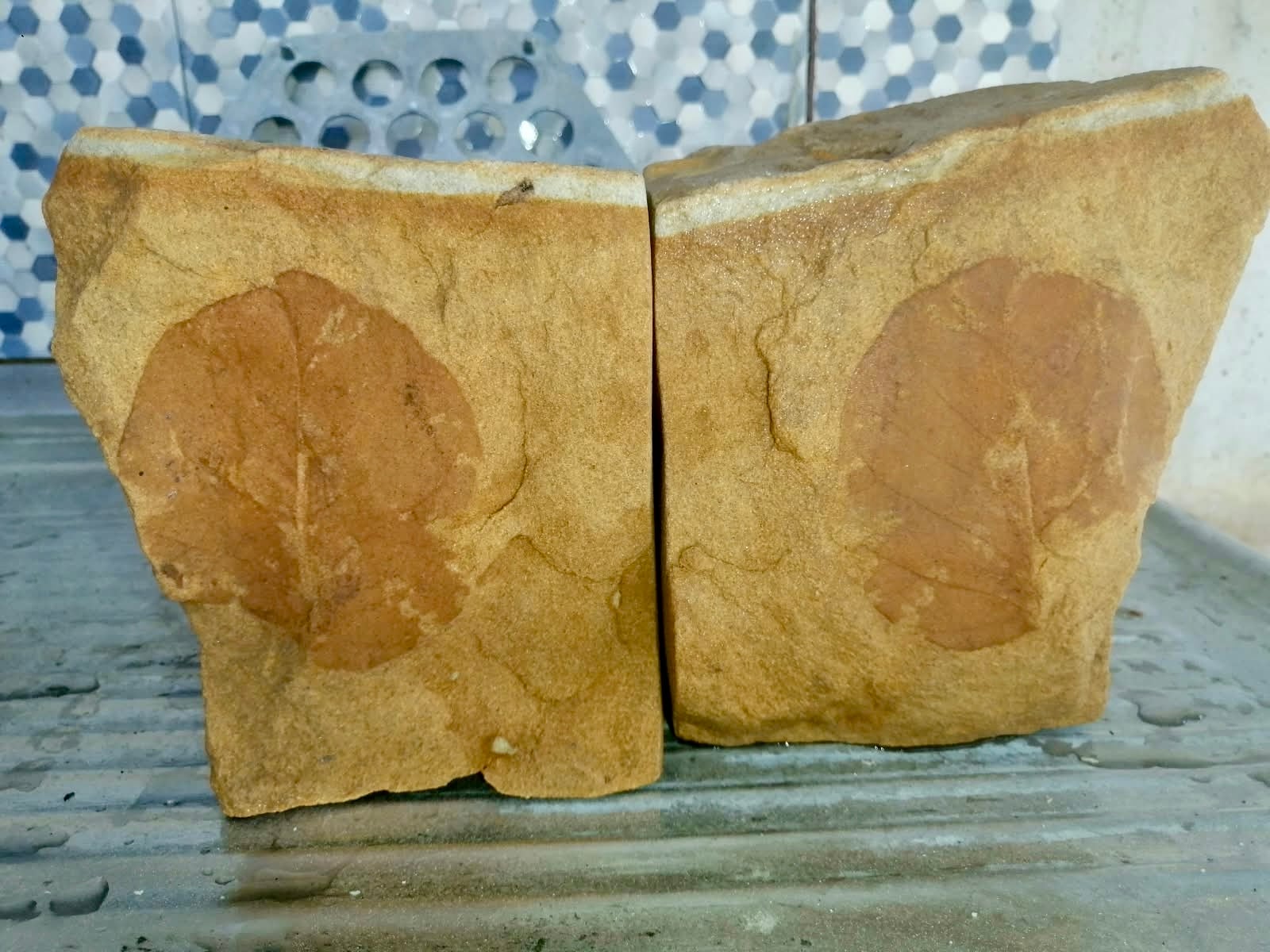
On one of those sandstones, the fossil impression of a leaf was left behind. Collector Luis Alejandro Gamboa found it in Patarrá about four years ago. A photograph of the fossil shows that the leaf remained printed on both faces of a block that split open right where it had been buried.
On a rough surface perfect for grinding, the delicate outline of a leaf—and even part of its veins—was preserved. Something uncommon on a wave-agitated beach. A group of scientists recently studied the fossil and found a notable resemblance to the sea grape (Coccoloba uvifera) or papaturro, although there is not enough information to assign it to that genus.
Years after finding it in Patarrá, he took it to a mineral fair, where it was awarded “Best National Fossil” and caught the attention of specialists.
A few weeks ago, I was able to see it at Luis Alejandro’s home. Since childhood, he has collected stones and minerals, trying to find out where they come from and what story they tell. The day after my visit, the fossil left his small home museum bound for the National Museum, where it will be preserved for future generations.
Like Luis Alejandro and a few other rock and mineral enthusiasts, I too approached sandstones long before knowing what they were called.
First came curiosity, and much later came quartz, the Miocene, and the Coris Formation. It all had started in a garden with music. From a knife brushing against a wet grindstone.